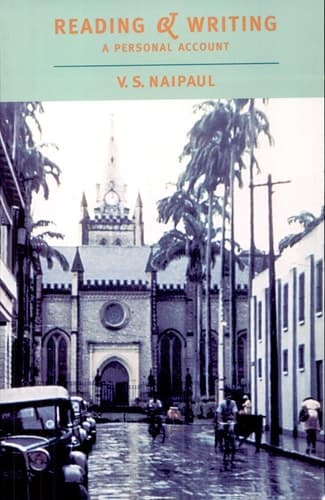
Reading and Writing A Personal Account
V. S. NaipaulPublished2000
Pages64
Formathardcover
PublisherNew York Review of Books
Synopsis
I was eleven, no more, when the wish came to me to be a writer; and then very soon it was a settled ambition. But for the young V. S. Naipaul, there was a great distance between the wish and its fulfillment. To become a writer, he would have to find ways of understanding three very different cultures: his family's half-remembered Indian homeland, the West Indian colonial society in which he grew up, and the wholly foreign world of the English novels he read.
In this essay of literary autobiography, V. S. Naipaul sifts through memories of his childhood in Trinidad, his university days in England, and his earliest attempts at writing, seeking the experiences of life and reading that shaped his imagination and his growth as a writer. He pays particular attention to the traumas of India under its various conquerors and the painful sense of dereliction and loss that shadows writers' attempts to capture the country and its people in prose.
Naipaul's profound reflections on the relations between personal or historical experience and literary form, between the novel and the world, reveal how he came to discover both his voice and the subjects of his writing, and how he learned to turn sometimes to fiction, sometimes to the travel narrative, to portray them truthfully. Along the way he offers insights into the novel's prodigious development as a form for depicting and interpreting society in the nineteenth century and its diminishing capacity to do the same in the twentiethÑa task that, in his view, passed to the creative energies of the early cinema.
As a child trying to read, I had felt that two worlds separated me from the books that were offered to me at school and in the libraries: the childhood world of our remembered India, and the more colonial world of our city. ... What I didn't know, even after I had written my early books of fiction ... was that those two spheres of darkness had become my subject. Fiction, working its mysteries, by indirections finding directions out, had led me to my subject. But it couldn't take me all the way. -V.S. Naipaul, from Reading & Writing
Recommendations
Generating recommendations…
Our AI is preparing recommendations for Reading and Writing A Personal Account. This usually takes under a minute.
About V. S. Naipaul
V
V. S. Naipaul
1932–2018
Vidiadhar Surajprasad Naipaul (17 August 1932 – 11 August 2018) was a Trinidadian-born British writer of works of fiction and nonfiction in English. He is known for his comic early novels set in Trinidad, his bleaker novels of alienation in the wider world, and his vigilant chronicles of life and travels. He published more than thirty books over fifty years. Naipaul's breakthrough novel *A House for Mr Biswas* was published in 1961. He won the Booker Prize in 1971 for his novel In a *Free State,* and the Jerusalem Prize in 1983. In 1990, he was awarded the Trinity Cross, Trinidad and Tobago's highest national honour. He received a knighthood in Britain in 1990, and the Nobel Prize in Literature in 2001. Some of his other works include *The Guerillas* (1975), *The Middle Passage* (1962) *A Bend in the River* (1979), *Among the Believers* (1981), *The Enigma of Arrival* (1987), *India: A Million Mutinies Now* (1990), *Beyond Belief* (1998) and *Half a Life* (2001).
View author page