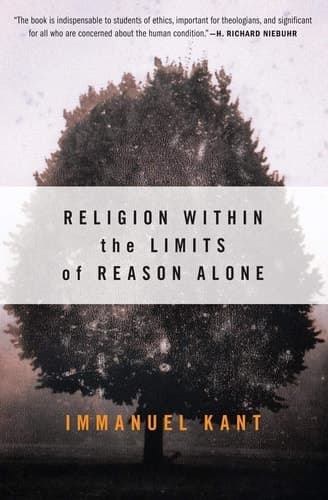
Religion Within the Limits of Reason Alone
Immanuel KantPublished1960
Pages352
Formatpaperback
PublisherHarperCollins
Synopsis
A Monumental Figure of Western Thought Wrestles with the Question of God
Immanuel Kant (1724-1804) is one of the most influential philosophers in the history of Western philosophy. His contributions have had a profound impact on almost every philosophical movement that followed him.
Kant's teachings on religion were unorthodox in that they were based on rationality rather than revelation. Though logically proving God's existence might be impossible, it is morally reasonable to "act as if there be a God." His strictly rational approach was considered so scandalous that the King of Prussia forbid him to teach or write further on religious subjects, which Kant obeyed until the king's death.
A work of major importance in the history of Western religious thought, Religion Within the Limits of Reason Alone represents a great philosopher's attempt to spell out the form and content of a type of religion grounded in moral reason and meeting the needs of an ethical life.
Recommendations
Generating recommendations…
Our AI is preparing recommendations for Religion Within the Limits of Reason Alone. This usually takes under a minute.
About Immanuel Kant
I
Immanuel Kant
1724–1804
Immanuel Kant was an 18th-century German philosopher from the Prussian city of Königsberg. Kant was the last influential philosopher of modern Europe in the classic sequence of the theory of knowledge during the Enlightenment beginning with thinkers John Locke, George Berkeley, and David Hume. Kant created a new perspective in philosophy which had widespread influences on philosophy continuing through to the 21st century. He published important works on epistemology, as well as works relevant to religion, law, and history. One of his most prominent works is the *Critique of Pure Reason*, an investigation into the limitations and structure of reason itself. It encompasses an attack on traditional metaphysics and epistemology, and highlights Kant's own contribution to these areas. The other main works of his maturity are the *Critique of Practical Reason*, which concentrates on ethics, and the *Critique of Judgment*, which investigates aesthetics and teleology. <sup>[1][1]</sup> [1]: https://en.wikipedia.org/wiki/Immanuel_Kant
View author page