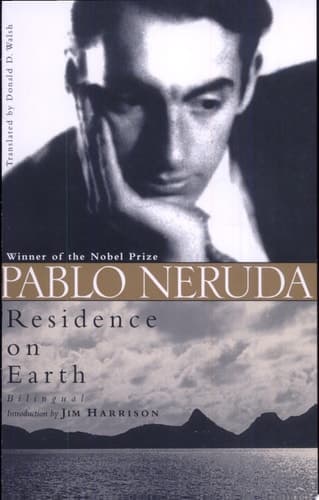
Residence on Earth
Pablo NerudaPublished2004
Pages366
Formatpaperback
PublisherNew Directions Publishing
Synopsis
A bilingual collection of Neruda's poems mostly written when Neruda was a self-exiled diplomat in isolated regions of South Asia. A vortex of time, of loneliness, cycles of the natural world, decay, destruction, silence, resurrection; of luminous solitude, blue oblivion, and of such deep melancholy that at one time Neruda considered renouncing the whole book and withdrawing it from circulation; of the erotic night, love's impulse, and memory's persistence; of odes to Lorca and lovers, elegies, songs, sonatas, and barcaroles; of the magnificent series of poems, Spain in our Hearts, that Republican soldiers of the Spanish Civil War printed at the eastern front; of sea waves, landslides, jellyfish and a planet of swords.--From publisher description.
Recommendations
Generating recommendations…
Our AI is preparing recommendations for Residence on Earth. This usually takes under a minute.
About Pablo Neruda
P
Pablo Neruda
1904–1973
Ricardo Eliécer Neftalí Reyes Basoalto (12 July 1904 – 23 September 1973), better known by his pen name and, later, legal name Pablo Neruda (/nəˈruːdə/; Spanish: [ˈpaβlo neˈɾuða]), was a Chilean poet-diplomat and politician who won the 1971 Nobel Prize in Literature. Neruda became known as a poet when he was 13 years old, and wrote in a variety of styles, including surrealist poems, historical epics, overtly political manifestos, a prose autobiography, and passionate love poems such as the ones in his collection Twenty Love Poems and a Song of Despair (1924). [source](https://en.wikipedia.org/wiki/Pablo_Neruda)
View author page