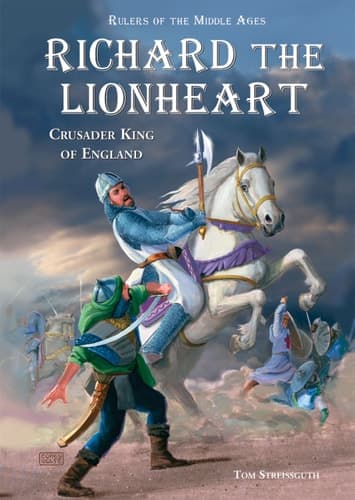
Richard the Lionheart Crusader King of England
Thomas StreissguthPublished2008
Pages160
FormatLibrary Binding
PublisherEnslow
Synopsis
Richard, later known as the Lionheart, was born a prince in a time of violence. He would face that challenge by becoming a great warrior and a brilliant strategist, a true figure of his time. Author Tom Streissguth brings history into sharp focus as he reveals the person behind the stories. Through a thorough exploration of Richard's upbringing, his military accomplishments, and his rivalries, Streissguth justifies Richard the Lionheart's status as a legendary ruler.
Recommendations
The Plantagenet Ancestry Being Tables Showing Over 7,000 of the Ancestors of Elizabeth (daughter of Edward IV and Wife of Henry VII) the Heiress of the Plantagenets
by William Harry Turton
Jones has that same gift Streissguth demonstrates for making medieval politics visceral and immediate—he'll show you how Richard's reign fits into the larger dynastic chess game that defined his family. Where Streissguth focuses on Richard's personal journey, Jones pulls back to show you the interconnected web of ambition and blood that made the Plantagenets such a consequential dynasty.
View book
Dragon Quest VIII Journey of the Cursed King : Official Strategy Guide
by Dan Birlew
This is a 1950s historical novel rather than modern biography, which gives it a different texture entirely—Druon writes medieval intrigue like a thriller, with the kind of page-turning momentum that makes you forget you're reading about 14th-century France. If you appreciated Streissguth's attention to the strategic mind of a warrior-king, Druon lets you inhabit that mind through dramatic reconstruction, showing you the paranoia and calculation that comes with absolute power.
View book
Seabiscuit An American Legend
by Laura Hillenbrand
I know this seems like a left turn from medieval crusades, but hear me out: Hillenbrand does something remarkable here that mirrors what drew you to Richard's story. She takes a figure (in this case, an underestimated racehorse) and reveals the complex person—or creature—behind the legend, exploring how determination and strategy overcome seemingly impossible odds. The narrative structure and her ability to make you care deeply about someone's competitive drive is exactly what makes Streissguth's Richard compelling.
View book
Magna Charta, Or, The Rise and Progress of Constitutional Civil Liberty in England and America Embracing the Period from the Norman Conquest to the Centennial Year of American Independence
by John Cleland Wells
Thorau traces how Richard's own ancestors—the Normans—went from Viking raiders to European royalty, which gives you the genealogical and cultural context for understanding what made Richard possible. You'll see how the warrior culture that shaped him was inherited, refined, and weaponized across generations, making his achievements feel less like individual genius and more like the culmination of a dynasty's evolution.
View book
Mediterranean Anarchy, Interstate War, and the Rise of Rome
by Arthur M. Eckstein
This one's about 18th-century India rather than medieval Europe, but Dalrymple writes with the same meticulous attention to how individual ambition and military brilliance reshape entire regions—he shows you how a handful of strategists and warriors carved out empires through cunning and force. If what captivated you about Richard was understanding how one person's vision and tactical genius could reshape the political landscape, Dalrymple demonstrates that same principle operating in a completely different time and place.
View bookAbout Thomas Streissguth
T
Thomas Streissguth
Born 1958
Biography coming soon.
View author page