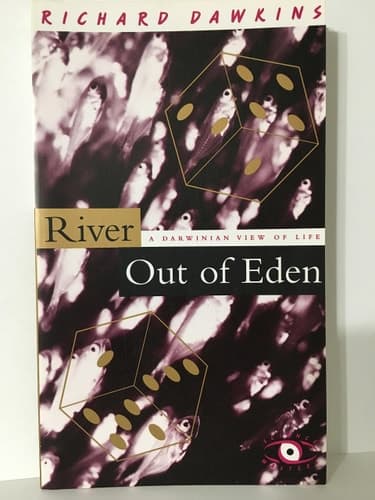
River Out of Eden A Darwinian View of Life
Richard DawkinsPublished1995
Pages192
Formathardcover
PublisherBasic Books
Synopsis
How did the replication bomb we call "life" begin and where in the world, or rather, in the universe, is it heading? Writing with characteristic wit and an ability to clarify complex phenomena (the New York Times described his style as "the sort of science writing that makes the reader feel like a genius"), Richard Dawkins confronts this ancient mystery.
Dawkins has been named by the London Daily Telegraph "the most brilliant contemporary preacher of Charles Darwin's theory of evolution." More than any other contemporary scientist, he has lent credence to the idea that human beings - indeed, all living things - are mere vehicles of information, gene carriers whose primary purpose is propagation of their own DNA.
In this new book, Dawkins explains evolution as a flowing river of genes, genes meeting, competing, uniting, and sometimes separating to form new species.
Filled with absorbing, at times alarming, stories about the world of bees and orchids, "designed" eyes and human ancestors, River Out of Eden answers tantalizing questions: Why are forest trees tall - wouldn't each survive more economically if all were short? Why is the sex ratio fifty-fifty when relatively few males are needed to impregnate many females? Why do we inherit genes for fatal illnesses?
Who was our last universal ancestor? Dawkins suggests that it was more likely to have been an Adam than an African Eve. By "reverse engineering," he deduces the purpose of life ("God's Utility Function"). Hammering home the crucial role of gradualism in evolution, he confounds those who argue that every element of, say, an eye has to function perfectly or the whole system will collapse.
But the engaging, personal, frequently provocative narrative that carries us along River Out of Eden has a larger purpose: the book illustrates the nature of scientific reasoning, exposing the difficulties scientists face in explaining life. We learn that our assumptions, intuitions, origin myths, and trendy intellectual and cultural "isms" all too often lead us astray.
Recommendations
Generating recommendations…
Our AI is preparing recommendations for River Out of Eden A Darwinian View of Life. This usually takes under a minute.
About Richard Dawkins
R
Richard Dawkins
Born 1941
Clinton Richard Dawkins, FRS, FRSL is a British ethologist, evolutionary biologist and popular science author. He was formerly Professor for Public Understanding of Science at Oxford and was a fellow of New College, Oxford. Dawkins came to prominence with his 1976 book *The Selfish Gene*, which popularised the gene-centred view of evolution and introduced the term meme. In 1982, he made a widely cited contribution to evolutionary biology with the concept, presented in his book *The Extended Phenotype*, that the phenotypic effects of a gene are not necessarily limited to an organism's body, but can stretch far into the environment, including the bodies of other organisms. Dawkins is well known for his candid criticism of creationism and intelligent design. In his 1986 book *The Blind Watchmaker*, he argued against the watchmaker analogy, an argument for the existence of a supernatural creator based upon the complexity of living organisms. Instead, he described evolutionary processes as analogous to a blind watchmaker. He has since written several popular science books, and makes regular television and radio appearances, predominantly discussing these topics. ([Source][1]) [1]: http://en.wikipedia.org/wiki/Richard_Dawkins
View author page