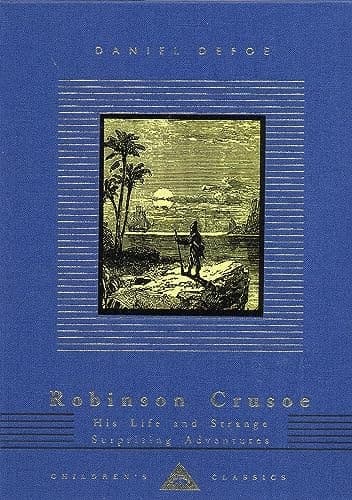
Robinson Crusoe
Daniel DefoePublished1993
Pages409
Formathardcover
PublisherEveryman's Library Children's Classics
Synopsis
Defoe's most celebrated story of Crusoe's shipwreck, his resourcefulness and ingenuity in his soliatry life on a desert island and his rescue of Man Friday has been abridged and retold many times since its publication (in two volumes) in 1719. It even appeared recently in graphic-novel form. In 1968 Kathleen Lines determined to make the original text more accessible to young readers by breaking Defoe's original, continuous narrative into chapters, slightly cutting Crusoe's long meditations, and compressing the relevant bits of THE FARTHER ADVENTURES into a neat Epilogue, so that readers learn what happened to Friday. The evocative engravings are reproduced from a mid-nineteenth-century edition published by Cassell, Petter & Gilpin.
Recommendations
Generating recommendations…
Our AI is preparing recommendations for Robinson Crusoe. This usually takes under a minute.
About Daniel Defoe
D
Daniel Defoe
1661–1731
Daniel Defoe, born Daniel Foe, was an English writer, journalist, and pamphleteer, who gained enduring fame for his novel Robinson Crusoe. Defoe is notable for being one of the earliest proponents of the novel, as he helped to popularise the form in Britain, and is even referred to by some as among the founders of the English novel. A prolific and versatile writer, he wrote more than 500 books, pamphlets, and journals on various topics (including politics, crime, religion, marriage, psychology and the supernatural). He was also a pioneer of economic journalism. ([Source][1]) [1]: http://en.wikipedia.org/wiki/Daniel_Defoe
View author page