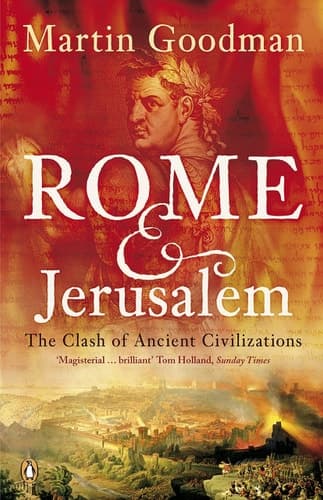
Rome and Jerusalem The Clash of Ancient Civilizations
Martin GoodmanPublished2008
Pages638
Formatpaperback
PublisherPenguin Books Limited
Synopsis
In Rome and Jerusalem: The Clash of Ancient Civilizations, Martin Goodman explores the history of a titanic struggle whose repercussions are still felt today. In 70CE, after four years of Jewish rebellion, Roman legions devastated the great city of Jerusalem. Sixty years later, its ruin was completed when Emperor Hadrian built a new city on top of it that Jews were forbidden even to enter. In this highly acclaimed book, Martin Goodman examines the background and course of this titanic conflict - from the political ambitions of Roman military leaders to the spread of Christian influence through the empire - and its lasting consequences. 'In this remarkable book Martin Goodman casts a truly fresh eye over well-known figures and events'
History Today 'Important and powerfully expressed ... The best available general account of a turning point not just in the history of the Roman Empire but also in the development of the modern West'
Simon Goldhill, The Times Higher Education Supplement 'Should be read by anyone seeking seriously to understand modern Middle Eastern tangles ... a lucid account of ancient tragedy'
Diarmaid MacCulloch, Guardian 'Splendid ... an important book, on a difficult subject: the reason why Romans sought to destroy the Jews and Judaism completely. Only one man would have written it'
Paul Johnson, Tablet Martin Goodman has divided his intellectual life between the Roman and Jewish worlds. He has edited both the Journal of Roman Studies and the Journal of Jewish Studies. He has taught Roman History at Birmingham and Oxford Universities, and is currently Professor of Jewish Studies at Oxford.
Recommendations
Josephus: The Jewish War, Books I-II (Loeb Classical Library No. 203) (Volume I)
by Josephus
Since you've just read Goodman's scholarly reconstruction of the Jewish-Roman conflict, reading Josephus's firsthand account as an eyewitness and participant will give you an extraordinary counterpoint—you'll see how ancient sources themselves shaped the narrative Goodman analyzes, and spot where Josephus's own biases and survival instincts colored his reporting of events.
View book
The Fall of the Roman Empire A New History of Rome and the Barbarians
by Peter Heather
Ward-Perkins examines how Rome's military and political systems unraveled across centuries, giving you the larger trajectory of imperial decline that Goodman's focused study illuminates from one crucial angle—you'll see Jerusalem's destruction not as an isolated tragedy but as part of Rome's broader pattern of crushing resistance and the eventual costs of that approach.
View book
Simians, Cyborgs, and Women The Reinvention of Nature
by Donna Jeanne Haraway
This is my surprise pick, but hear me out: Wulf writes about how one person's observations and ideas ripple through centuries and reshape how we understand the world—much like how Goodman shows us how the Jerusalem conflict fundamentally altered the trajectory of Western civilization and religious thought. It's history as intellectual archaeology, but through a completely different lens.
View book
The Siege
by Helen Dunmore
Dunmore's novel about the Siege of Leningrad captures something Goodman's scholarly account necessarily cannot: the intimate human cost of imperial conflict and siege warfare, the way ordinary people experience the collision of great powers. It's fiction, but it'll deepen your emotional understanding of what the siege of Jerusalem meant beyond the historical record.
View book
Pagan and Christian in an Age of Anxiety: Some Aspects of Religious Experience from Marcus Aurelius to Constantine (The Wiles Lectures)
by E. R. Dodds
Dodds explores the spiritual and psychological crisis of the late Roman world—the very period when Christianity was spreading through the empire that Goodman mentions as crucial context. This 1965 work examines how people actually *felt* during this transformation, the anxiety and searching that made new religions compelling, which gives you the cultural atmosphere surrounding the events Goodman documents.
View bookAbout Martin Goodman
Biography coming soon.
View author page