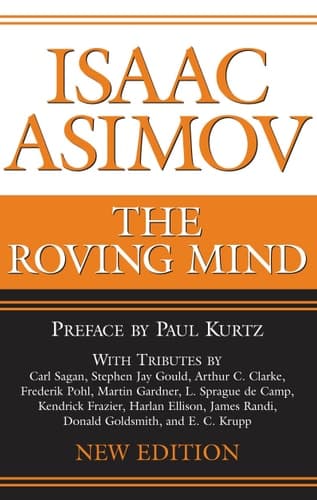
Roving Mind
Isaac AsimovPublished1997
Pages380
Formatpaperback
PublisherGlobe Pequot Publishing
Essays&Afterlife < Death < Life Cycle < Human Body < Physical Life < Personal Existence < MankindAbsent Lovers < Love < Personal Relationships < Personal Existence < MankindAdolescence < Youth < Life Cycle < Human Body < Physical Life < Personal Existence < MankindAgeing Process < Life Cycle < Human Body < Physical Life < Personal Existence < Mankind
Synopsis
Isaac Asimov's death on April 6, 1992, was a great loss to the world of literary science and freethought. The prolific author's vision is unmatched today, and his pointed honesty shines through in The Roving Mind, now reissued in this special tribute edition.This collection of essays is wide-ranging, reflecting Asimov's extraordinary skill in disseminating knowledge from across the spectrum of human thought. Some of the areas explored in this volume of 62 essays include creationism, pseudoscience, censorship, population, philosophy of science, transportation, computers and corporations of the future, and astronomy. His predictions about cloning which has only recently become the topic of public debate the theory of "technophobia," and other scientific developments are astounding. In a lighter tone, Asimov includes several personal stories from his life including thoughts on his style of writing and memories of family in younger days.With tributes by Arthur C. Clarke, L. Sprague de Camp, Harlan Ellison, Kendrick Frazier, Martin Gardner, Donald Goldsmith, Stephen Jay Gould, E. C. Krupp, Frederik Pohl, and Carl Sagan
Recommendations
Generating recommendations…
Our AI is preparing recommendations for Roving Mind. This usually takes under a minute.
About Isaac Asimov
I
Isaac Asimov
1920–1992
Asimov was born sometime between October 4, 1919 and January 2, 1920 in Petrovichi in Smolensk Oblast, RSFSR (now Russia), the son of a Jewish family of millers. Although his exact date of birth is uncertain, Asimov himself celebrated it on January 2. His family emigrated to Brooklyn, New York and opened a candy store when he was three years old. He taught himself to read at the age of five. He began reading the science fiction pulp magazines that his family's store carried. Around the age of eleven, he began to write his own stories, and by age nineteen, he was selling them to the science fiction magazines. He graduated from Columbia University in 1939. He married Gertrude Blugerman in 1942. During World War II he worked as a civilian at the Philadelphia Navy Yard's Naval Air Experimental Station. After the war, he returned to Columbia University and earned a Ph.D. in biochemistry in 1948. He then joined the faculty of the Boston University School of Medicine until 1958, when he became a full-time writer. His first novel, [Pebble in the Sky](https://openlibrary.org/works/OL46402W), was published in 1950. He and his wife divorced in 1973, and he married Janet O. Jeppson the same year. He was a highly prolific writer, having written or edited more than 500 books and an estimated 9,000 letters and postcards.
View author page