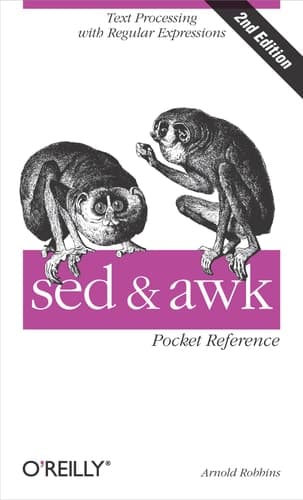
Sed and Awk: Pocket Reference, 2nd Edition
Arnold RobbinsPublished2002
Pages52
Formatpaperback
PublisherO'Reilly Media
Synopsis
For people who create and modify text files, sed and awk are power tools for editing. sed, awk, and regular expressions allow programmers and system administrators to automate editing tasks that need to be performed on one or more files, to simplify the task of performing the same edits on multiple files, and to write conversion programs.
The sed & awk Pocket Reference is a companion volume to sed & awk, Second Edition, Unix in a Nutshell, Third Edition, and Effective awk Programming, Third Edition. This new edition has expanded coverage of gawk (GNU awk), and includes sections on: An overview of sed and awk?s command line syntax Alphabetical summaries of commands, including nawk and gawk Profiling with pgawk Coprocesses and sockets with gawk Internationalization with gawk A listing of resources for sed and awk users This small book is a handy reference guide to the information presented in the larger volumes. It presents a concise summary of regular expressions and pattern matching, and summaries of sed and awk.
Arnold Robbins, an Atlanta native now happily living in Israel, is a professional programmer and technical author and coauthor of various O'Reilly Unix titles. He has been working with Unix systems since 1980, and currently maintains gawk and its documentation.
Recommendations
The Scheme Programming Language, ANSI Scheme
by R. Kent Dybvig
You've got the pocket reference down—now you're ready for the authoritative deep dive. Aho co-created awk itself, and this book reads like getting the design philosophy straight from the source. Where Robbins gives you the what, Aho gives you the why, with elegant examples that show how to think in awk rather than just syntax-check your scripts.
View book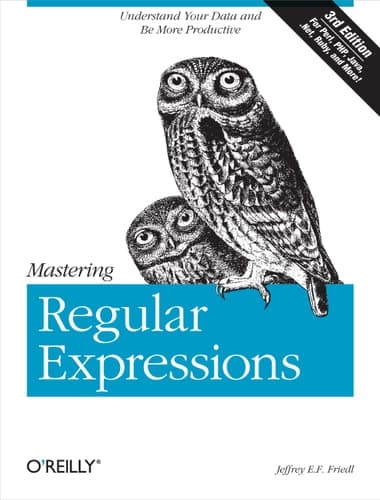
Mastering Regular Expressions: Powerful Techniques for Perl and Other Tools (Nutshell Handbooks)
by Jeffrey E. F. Friedl
Regular expressions are the secret language hiding inside your sed and awk commands, and Friedl treats them like they deserve their own book—because they do. He moves from pattern-matching fundamentals into the psychology of how regex engines actually work, which transforms you from someone who copies regex snippets into someone who understands why they work.
View book
The UNIX Programming Environment
by Brian W. Kernighan
Kernighan (who literally helped invent Unix) shows you the entire ecosystem that sed and awk live in—pipes, filters, shell scripting, the philosophy of doing one thing well. It's from 1984, so it predates your pocket reference by nearly two decades, but that's exactly why it's revelatory: you'll see how these tools emerged from a coherent vision rather than appearing fully formed.
View book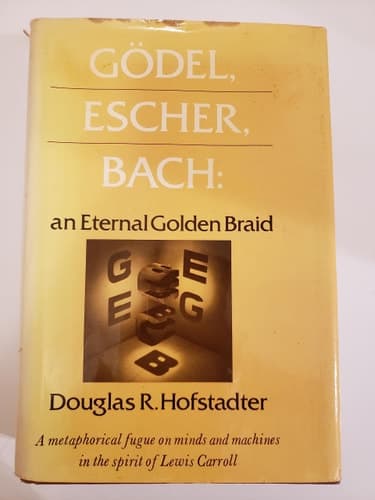
Gödel, Escher, Bach An Eternal Golden Braid
by Douglas R. Hofstadter
This is the curveball—but hear me out. You've been learning formal systems for pattern-matching and text transformation, which is really about how symbols can encode meaning and rules can generate complexity. Hofstadter explores that same territory through music, art, and mathematics, showing you how recursive structures and self-reference create emergence. It'll rewire how you think about what code actually *is*.
View book
Practical Management of the Balance Disorder Patient (Singular Audiology Text)
by Neil T. Shepard
You've mastered sed and awk for batch processing—now learn vim, the editor where those same regex and text-manipulation principles live interactively. Neil teaches vim not as a collection of commands but as a language where you compose editing operations, which is conceptually similar to how you compose sed scripts. It's the natural next step for someone who thinks in terms of text transformation patterns.
View bookAbout Arnold Robbins
Biography coming soon.
View author page