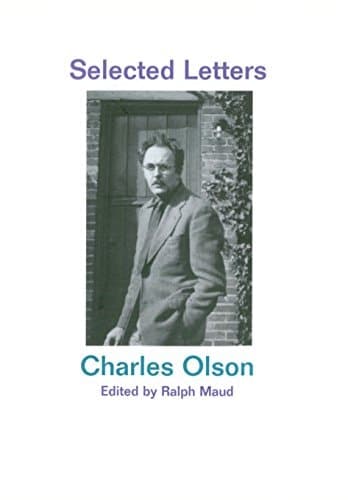
Selected Letters Charles Olson
Charles OlsonPublished2000
Pages464
Formathardcover
PublisherUniversity of California Press
Synopsis
For Charles Olson, letters were not only a daily means of communication with friends but were at the same time a vehicle for exploratory thought. In fact, many of Olson's finest works, including Projective Verse and the Maximus Poems, were formulated as letters. Olson's letters are important to an understanding of his definition of the postmodern, and through the play of mind exhibited here we recognize him as one of the vital thinkers of the twentieth century.
In this volume, edited and annotated by Ralph Maud, we see Olson at the height of his powers and also at his most human. Nearly 200 letters, selected from a known 3,000, demonstrate the wide range of Olson's interests and the depth of his concern for the future. Maud includes letters to friends and loved ones, job and grant applications, letters of recommendation, and Black Mountain College business letters, as well as correspondence illuminating Olson's poetics. As we read through the letters, which span the years from 1931, when Olson was an undergraduate, to his death in 1970, a fascinating portrait of this complex poet and thinker emerges.
Recommendations
Generating recommendations…
Our AI is preparing recommendations for Selected Letters Charles Olson. This usually takes under a minute.
About Charles Olson
C
Charles Olson
1910–1970
Charles Olson was a second generation American modernist poet who was a crucial link between earlier figures like Ezra Pound and William Carlos Williams and the New American poets, a rubric which includes the New York School, the Black Mountain School, the Beat poets, and the San Francisco Renaissance. Consequently, many postmodern groups, such as the poets of the Language School, include Olson as a primary and precedent figure. Across the Atlantic, these various poetic movements have exerted a deep and ongoing influence on an important array of alternative and experimental writers, including Roy Fisher, Geoffrey Hill, JH Prynne and Edwin Morgan, behind whose works lurks Olson's ghost of language-driven inventiveness. ([Source][1].) [1]:http://en.wikipedia.org/wiki/Charles_Olson
View author page