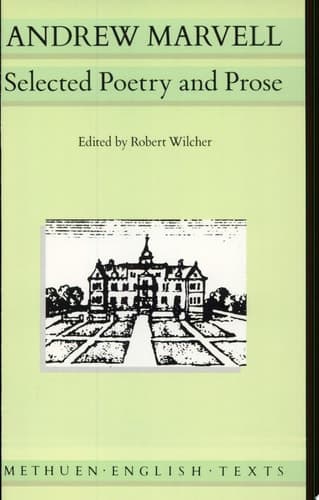
Selected Poetry and Prose
Andrew MarvellPublished1986
Pages292
Formatpaperback
PublisherPsychology Press
Synopsis
Includes Marvell's satirical and polemical prose, his formal and informal letters, as well as the main body of lyric poetry on which his modern reputation rests.
Recommendations

The Rape of the Lock
by Alexander Pope
Pope's mock-heroic poem shares Marvell's gift for weaponizing wit—both poets use formal, elegant verse to skewer their subjects with surgical precision. Where Marvell's satire often lurks beneath surface charm, Pope announces his mockery outright, but the underlying technique of using classical forms to expose contemporary absurdity will feel immediately familiar to you.
View book
Find what the Sailor Has Hidden Vladimir Nabokov's Pale Fire
by Priscilla Meyer
This is where I'm asking you to trust me: Nabokov's novel-as-poem-with-commentary shares Marvell's obsession with unreliable narration and layered meaning. The way Marvell embeds political argument within love poetry finds its modern echo in Nabokov's structure—you're constantly questioning what's real, what's invented, and whether the narrator is genius or madman. It's formally playful in ways that will delight anyone who appreciated Marvell's technical control.
View book
The Love Poems of John Donne
by John Donne
Donne was Marvell's great predecessor in the metaphysical tradition, but where Donne tends toward spiritual anguish and intellectual paradox, Marvell brings a cooler, more ironic distance. Reading Donne after Marvell lets you see how Marvell refined the metaphysical style—taking Donne's conceits and sharpening them into instruments of seduction and political argument.
View book
The Savage Detectives A Novel
by Roberto Bolaño
This might seem like a left turn, but stay with me: Bolaño's novel is structured like a literary investigation, with fragments, letters, and testimonies building an obsessive portrait of a poet and his circle—much like how Marvell's collected works require you to piece together the man from his formal poems, satires, and correspondence. Both demand active readership; both reward attention to voice and tone across different registers. The prose-poetry boundary dissolves in both.
View bookAbout Andrew Marvell
A
Andrew Marvell
1621–1678
Biography coming soon.
View author page