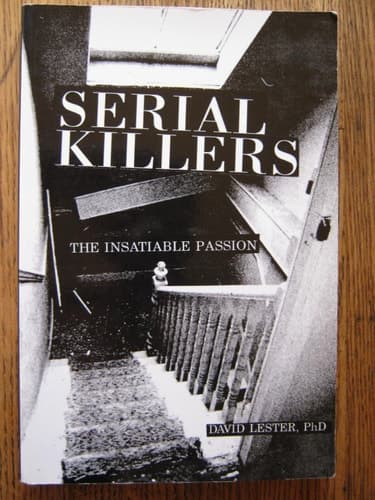
Serial Killers: The Insatiable Passion
David LesterPublished1995
Pages196
Formatpaperback
PublisherThe Charles Press, Publishers
Synopsis
This bestselling book has become a staple of every serious true crime book collector's library. One of the most reliable concise sources of information available about serial killers and their crimes, this book offers a psychological and sociological analysis of this most frightening yet fascinating criminal. Psychologist David Lester, recognized worldwide as a leading authority on death-both in the fields of suicide and homicide-offers a much-needed assessment of whether or not there is a dependable and useable psychological profile of the serial killer. Separating the facts from the myths by combining documented case histories of notable serial killers with behavioral research, Serial Killers: The Insatiable Passion has been welcomed and applauded as an important addition to the literature on serial killers by criminologists, psychologists, sociologists, law enforcement and true crime buffs alike.
Recommendations
The Anatomy of Motive The FBI's Legendary Mindhunter Explores the Key to Understanding and Catching Violent Criminals
by John E. Douglas
Douglas, the FBI's legendary profiler who literally invented criminal profiling, takes Lester's psychological framework and grounds it in his actual case files from decades of interrogations. Where Lester synthesizes research, Douglas walks you through his thinking process as he sat across from killers—it's the practical application of the theories you've just absorbed, written with the authority of someone who actually shaped how law enforcement thinks about these crimes.
View book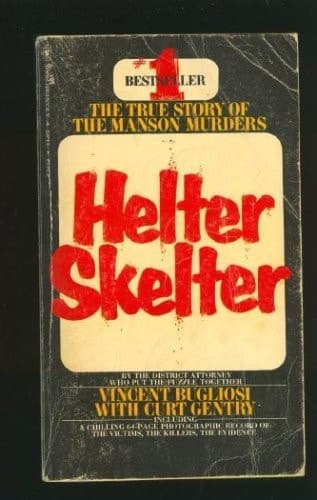
Helter Skelter The True Story of the Manson Murders
by Vincent Bugliosi
Rather than analyzing serial killers in the abstract, Bugliosi—the prosecutor who convicted Manson—reconstructs the Tate-LaBianca murders with the precision of someone who had to prove every detail in court. It's a masterclass in how investigative methodology actually works, and it'll deepen your understanding of the gap between psychological profiles and the messy reality of solving these cases.
View book
The Devil in the White City Murder, Magic and Madness at the Fair that Changed America
by Erik Larson
This is your surprise pick—it's narrative history rather than clinical analysis, but Larson weaves H.H. Holmes's murders into the 1893 Chicago World's Fair with such atmospheric precision that you'll see how a killer operates within a specific historical moment. It complements Lester's psychological approach by showing you the *context* that enabled one of America's first documented serial murderers, making the sociology of crime feel as immediate as the psychology.
View book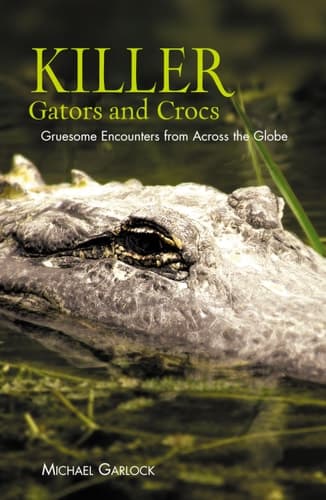
Killer Gators and Crocs Gruesome Encounters from Across the Globe
by Michael Garlock
Published nearly two decades after Lester's book, Douglas updates the conversation with cases from the modern era and reflects on how profiling has evolved. His case-by-case breakdown shows you serial killers from the 1970s through 2000s, giving you the chronological extension of Lester's work while maintaining that same blend of psychology and documented crime.
View book
A Mind to Murder
by P. D. James
Fallon approaches this from neuroscience rather than traditional psychology—he's a brain researcher who discovered he has the neural markers of a psychopath, and he uses that personal revelation to interrogate whether killers are made or born. It's a completely different angle from Lester's sociological-psychological framework, asking harder questions about biology, free will, and whether profiles can ever truly predict behavior.
View bookAbout David Lester
D
David Lester
Born 1942
Biography coming soon.
View author page