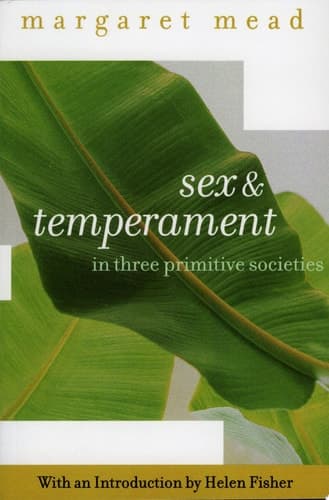
Sex and Temperament In Three Primitive Societies
Margaret MeadPublished2001
Pages352
Formatpaperback
PublisherHarper Collins
Synopsis
First published in 1935, Sex & Temperament is a fascinating and brilliant anthropological study of the intimate lives of three New Guinea tribes from infancy to adulthood. Focusing on the gentle, mountain-dwelling Arapesh, the fierce, cannibalistic Mundugumor, and the graceful headhunters of Tchambuli -- Mead advances the theory that many so-called masculine and feminine characteristics are not based on fundamental sex differences but reflect the cultural conditioning of different societies. This edition, prepared for the centennial of Mead's birth, features introductions by Helen Fisher and Mead's daughter, Mary Catherine Bateson.
A precursor to Mead's illuminating Male & Female, Sex & Temperament lays the groundwork for her lifelong study of gender differences.
Recommendations

Simone de Beauvoir's the Second Sex
by George Myerson
Where Mead observes how culture shapes gender across three societies, de Beauvoir takes that insight and runs it through existentialist philosophy, arguing that 'one is not born, but rather becomes, a woman.' You'll recognize Mead's fingerprints all over de Beauvoir's thinking, but she pushes the analysis into territory Mead was circling around—the question of how women internalize their own subordination.
View book
Quilting and Braiding The Feminist Christologies of Sallie McFague and Elizabeth A. Johnson in Conversation
by Shannon Schrein
Kimmerer, a botanist and member of the Citizen Potawatomi Nation, does something Mead couldn't quite do from the outside—she writes from within an indigenous knowledge system while also holding scientific training. The book reads like a conversation between worldviews rather than an outsider's analysis, and it'll make you reconsider what Mead was actually seeing versus what her cultural lens prevented her from seeing.
View book
The Argonauts
by Aleister Crowley
This is the curveball—part theory, part memoir, part love letter to a partner's transition. Nelson uses Mead as a jumping-off point to ask what happens when we stop thinking of gender as something societies *condition* into people and start thinking about it as something people *create* through their own choices and relationships. It's experimental in form but deeply readable, and it updates Mead's framework for a world she couldn't have imagined.
View book
I Sailed the Sky in a Silver Ship Coming of Age in the Marble City
by Theresa Lennon Blunt
I'm recommending this not because it's a comfortable read, but because Freeman's 1983 critique of Mead's fieldwork methods will deepen your engagement with what you just finished. He challenges her conclusions about Samoan sexuality and adolescence, and whether you ultimately agree with him or not, you'll finish this understanding how anthropology itself is a cultural practice—observers bring their own biases to what they observe.
View book
The Apocalyptic Vision of Mikhail Bulgakov's the Master and Margarita (Studies in Slavic Language & Literature)
by Edward E. Ericson
This might seem like a complete departure, but Bulgakov's novel is fundamentally about how different societies and belief systems create different realities—much like Mead's three tribes inhabit different social worlds. The book moves between Soviet Moscow and ancient Jerusalem, showing how the same human story gets filtered through completely different cultural and moral frameworks. It's a novel that thinks like an anthropologist.
View bookAbout Margaret Mead
M
Margaret Mead
1901–1978
Biography coming soon.
View author page