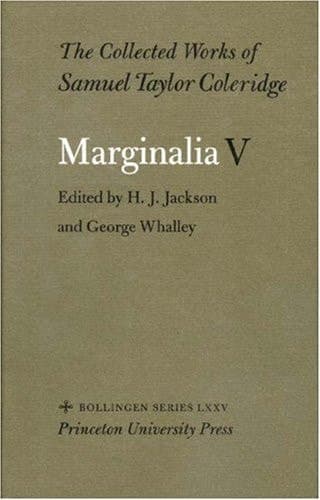
Sherlock to Unidentified
Samuel Taylor ColeridgePublished2000
Pages896
Formathardcover
PublisherPrinceton University Press
Synopsis
In his introduction to this edition of Coleridge's Marginalia, the late George Whalley wrote, "There is no body of marginalia--in English, or perhaps in any other language--comparable with Coleridge's in range and variety and in the sensitiveness, scope, and depth of his reaction to what he was reading." The Princeton edition of the Marginalia, of which this is the fifth volume, will bring together over eight thousand notes, many never before printed, varying from a single word to substantial essays. In alphabetical order of authors, the notes are presented literatim from the original manuscripts whenever the annotated volumes can be found. Each note is preceded by the passage of the original text that appears to have provoked Coleridge's comment. Texts in foreign languages are followed by translations.
The present volume comprises annotations on more than sixty books (from Sherlock to "Unidentified"), including well-known works by Sir Philip Sidney, Southey, Spinoza, Swift, and Tennyson. There are extensive notes on texts by Heinrich Steffens, Emanuel Swedenborg, and Jeremy Taylor; on two histories of philosophy by Thomas Stanley and W. G. Tennemann; and also on the writings of St. Teresa of Avila. The subjects addressed range from literature and philosophy through religion, politics, history, and biography, to travel-writing and science.
Recommendations
Generating recommendations…
Our AI is preparing recommendations for Sherlock to Unidentified. This usually takes under a minute.
About Samuel Taylor Coleridge
S
Samuel Taylor Coleridge
1772–1834
Samuel Taylor Coleridge was an English poet, Romantic, literary critic and philosopher who, with his friend William Wordsworth, was one of the founders of the Romantic Movement in England and one of the Lake Poets. He is probably best known for his poems The Rime of the Ancient Mariner and Kubla Khan, as well as for his major prose work Biographia Literaria. His critical work, especially on Shakespeare, was highly influential, and he helped introduce German idealist philosophy to English-speaking culture. He coined many familiar words and phrases, including the celebrated suspension of disbelief. He was a major influence, via Emerson, on American transcendentalism. ([Source][1].) [1]:http://en.wikipedia.org/wiki/Samuel_Taylor_Coleridge
View author page