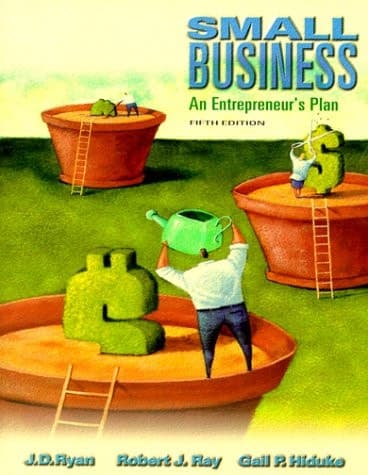
Small Business An Entrepreneur's Plan
Joseph Daniel RyanPublished1999
Pages378
Formatpaperback
PublisherDryden Press
Synopsis
Presents a road map to success in small business. Guides you through the bustling marketplace through trends, Target Customers, & promotion; through shopping malls, spreadsheets, & through franchise opportunities, all the way to your own new venture. Paper.
Recommendations
Leap of Strength A Personal Tour Through the Months Before and Years After You Start Your Own Business
by Walt Sutton
Where Ryan gives you the foundational roadmap, Ries takes you into the iterative reality of how modern startups actually test their assumptions in the marketplace. You'll recognize the customer-focused thinking from your first book, but here it's weaponized through rapid experimentation—less about the perfect business plan upfront, more about learning what your customers actually want through validated feedback loops.
View book
Beyond the Goal: Eliyahu Goldratt Speaks on the Theory of Constraints (Your Coach In A Box)
by Eliyahu M. Goldratt
This one's written as a novel about a factory manager solving production crises, which might feel like a departure from Ryan's straightforward guide—but it's actually the perfect next step. It teaches systems thinking and constraint management through narrative rather than bullet points, so when you're running that venture you planned, you'll understand *why* bottlenecks form and how to eliminate them, not just that they exist.
View book
Friendship Bands Braiding, Weaving, Knotting
by Marlies Busch
I'm recommending this as your surprise pick because it fundamentally reframes what 'business success' means. Kimmerer, a botanist and member of the Citizen Potawatomi Nation, explores reciprocity and sustainable relationships—concepts that will reshape how you think about customer relationships, supplier networks, and what you actually want your venture to contribute. It won't teach you spreadsheets, but it might teach you why your spreadsheets should measure something beyond profit.
View book
The E-Myth Revisited CD : Why Most Small Businesses Don't Work and What to do about it
by Michael E. Gerber
Published in 1995 (close to Ryan's era), this book addresses the gap between *starting* a business and *scaling* it—the moment when your personal hustle stops working and you need systems. Gerber's obsession with replicable processes and documentation will feel like a natural evolution from Ryan's franchise discussion, but he goes deeper into the psychology of why most small businesses plateau.
View book
Competing Against America: Why Canada Has Fallen Behind in the Race for Talent and Wealth (And What To Do About It)
by Michael Alexander
Christensen shifts your perspective from 'how do I reach my target customer' to 'what job is my customer actually trying to accomplish?' It's a more sophisticated framework for the market analysis you learned in Ryan's book—less about demographics and promotion channels, more about the underlying motivations that make someone choose your product over alternatives or doing nothing at all.
View bookAbout Joseph Daniel Ryan
Biography coming soon.
View author page