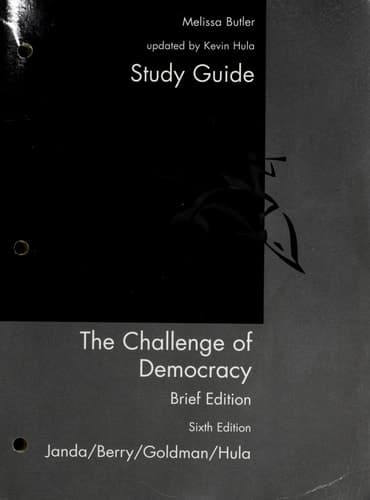
Study Guide Used with ... Janda-The Challenge of Democracy
JandaPublished2005
Pages160
Formatpaperback
PublisherWadsworth
Synopsis
Product description Available for individual sale and for packaging with the text, this study guide contains an overview of each chapter, exercises on reading tables and graphs, topics for student research, and multiple-choice questions for practice. About the Author Kenneth Janda (Ph.D., Indiana, 1961) is the Payson S. Wild Professor Emeritus of Political Science at Northwestern University. He has published extensively in the areas of political science, research methodology, and the use of computer technology in political science. In 2000, he won the Samuel Eldersveld Lifetime Achievement Award from the Political Organizations and Parties Section of the American Political Science Association.Jeffrey M. Berry (Ph.D., Johns Hopkins, 1974) is the John Richard Skuse, Class of 1941 Professor of Political Science at Tufts University. His books include THE REBIRTH OF URBAN DEMOCRACY (1993), THE NEW LIBERALISM (1999), and THE INTEREST GROUP SOCIETY (4th ed., 2006). He is also the recipient of the Leon Epstein Award for his book, A VOICE FOR NONPROFITS (2003).Jerry Goldman (Ph.D., Johns Hopkins, 1974) is professor of political science at Northwestern University. His research interests are judicial politics, constitutional law, and information technology and politics, and he is the creator of The OYEZ Project, a public archive devoted to the U.S. Supreme Court. He has received many awards, including the American Bar Foundation's Sliver Gavel for increasing the public's understanding of law and the Roman & Littlefield Prize for Teaching Innovation.Kevin W. Hula is Associate Professor of Political Science at Loyola College in Maryland, where he teaches the introductory American Government course, as well as courses in the presidency, intelligence organizations, and interest groups. His research is in interest groups and the executive branch.
Recommendations
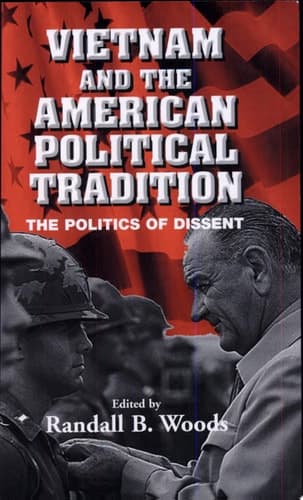
Vietnam and the American Political Tradition The Politics of Dissent
by Randall B. Woods
Hofstadter writes political history the way a detective pieces together a case—examining how American leaders' personal contradictions shaped the nation's ideological conflicts. Where Janda's textbook gives you the framework, Hofstadter shows you the human messiness underneath, making the abstract principles of democracy feel like they actually matter to real people with competing visions.
View book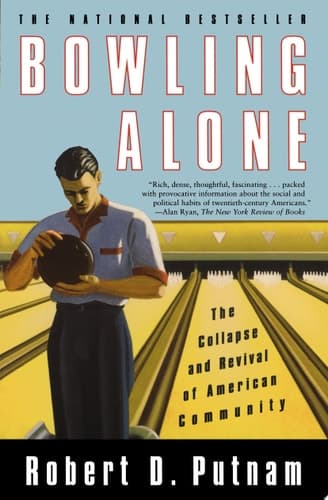
Bowling Alone The Collapse and Revival of American Community
by Robert D. Putnam
Putnam takes the democratic participation you've been studying in abstract terms and asks a deceptively simple question: why are Americans actually joining fewer clubs, bowling leagues, and civic organizations? He builds his argument with the same methodical data analysis you've been practicing with graphs and tables, but applies it to something you can observe in your own neighborhood.
View book
The Apocalyptic Vision of Mikhail Bulgakov's the Master and Margarita (Studies in Slavic Language & Literature)
by Edward E. Ericson
Here's the curveball: a 1960s Soviet satirical novel that's actually a brilliant political allegory about power, censorship, and how systems control narrative. It won't feel like a civics lesson—it reads like magical realism meets dark comedy—but it'll make you think about how authoritarian governments manipulate information and suppress dissent in ways no textbook can quite capture.
View book
The Essential Federalist and Anti-Federalist Papers
by Alexander Hamilton
Rather than reading about the Constitution's framework, read the actual arguments Hamilton and Madison made to convince people to ratify it—you'll see democracy as a contested idea where brilliant people genuinely disagreed about how to balance power. It's dense, but it's the primary source that explains *why* the system was designed the way Janda describes it.
View book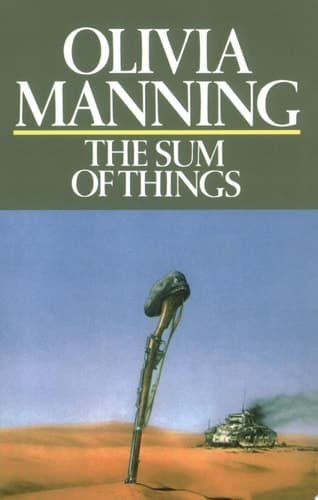
The Sum of Things
by Olivia Manning
Currid-Halkett examines how status and consumption patterns actually shape political behavior and social hierarchy in modern America—it's contemporary sociology that explains the *real* incentives driving the political actors and interest groups you've been reading about. She writes with the precision of an academic but the accessibility of someone genuinely curious about why people do what they do.
View bookAbout Janda
Biography coming soon.
View author page