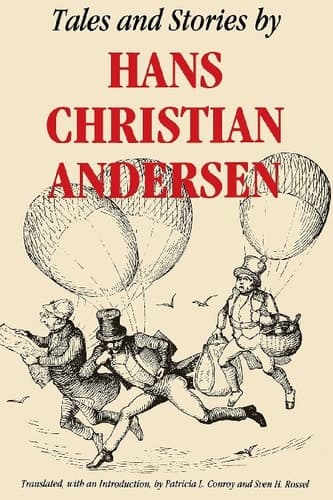
Tales and Stories
Hans Christian AndersenPublished1980
Pages279
Formathardcover
PublisherUniversity of Washington Press
Synopsis
Stories that have delighted children and fascinated adults for over a century are the heritage of Hans Christian Andersen. This collection has been selected and translated with the growing audience of adults--both students and general readers--in mind, and displays the full range of Andersen's authorship, from parable to science fiction.
In this fresh, contemporary translation Rossel and Conroy have endeavored to "preserve for the English-speaking audience the engaging duplicity of Andersen's style, the tension of play between his sympathetic conversational tone and his use of the studied effect." This is a tension between the simplicity of stories intended to be read aloud to children ad the subtlety of the allegory skillfully woven into each for the adults who would be listening and "must have something to think about," as Andersen said.
The introductions provide an overview of Andersen's life and struggle to become an author, as well as an analysis of his contributions as an artist and storyteller. Each story has also been provided with an endnote giving publication dates, information about the genesis of the tale, and relevant comments by Andersen and other.
Readers who remember with nostalgia such tales as "The Ugly Duckling" and "The Little Match Girl" may be surprised to find the biting satire in many of the stories, such as "The Nightingale" and "The Gardener and the Lord and Lady," the revealing self-portraits of the author in "The Sweethearts," "The Butterfly," and "The Shadow," the mysticism of "The story of a Mother" and "The Bell" the prophetic quality of "In a Thousand Years Time," and the complexity and charm of "the Snow Queen."
The book contains the drawings of Vilhelm Pedersen and Lorenz Frolich that originally appeared in the first illustrated Danish editions of Andersen's tales and stories.
Recommendations
Generating recommendations…
Our AI is preparing recommendations for Tales and Stories. This usually takes under a minute.
About Hans Christian Andersen
H
Hans Christian Andersen
1805–1875
Hans Christian Andersen was born in Odense, Denmark, to a father who claimed to be related to nobility. After school, he worked as a weaver's apprentice and as a tailor's assistant. At 14, he moved to Copenhagen to be an actor, and was accepted into the Royal Danish Theatre. His career ended when his voice changed, and he decided to become a writer. He published his first story, The Ghost at Palnatoke's Grave, in 1822. An acquaintance paid all expenses to send him to grammar school in Slagelse. He also attended school at Elsinore until 1827. He later admitted that his school years were the darkest and bitterest of his life. After school, Andersen resumed writing. In 1829, he started to see his first successes, publishing a short story, "A Journey on Foot from Holmen's Canal to the East Point of Amager", and a collection of poems. In 1833 he received a traveling grant from the King and set out to travel through Europe. He published his first novel, The Improvisatore, in 1835. He also published the first set of Fairy Tales, following up with more stories in 1836 and 1837. Although they were not initially successful, they have become his best-known works. He wrote a well-received poem, Jeg er en Skandinav, which celebrated Scandinavism, in 1839. In 1857, following a visit to Charles Dickens in England, Andersen met Danish actor Lauritz Eckardt and Danish ballet dancer Harald Scharff in Paris. In 1860, he met them again in Bavaria, and the three of them spent a week in Munich together. Anderson fell in love with Scharff, and started corresponding with him when Scharff and Eckardt left Munich. They were united when Andersen returned to Copenhagen in 1862. Their affair lasted for over a year before it was ended by Scharff, and Andersen did not have another serious relationship. In 1872, Andersen was injured in a fall, and he died of his injuries in 1875.
View author page