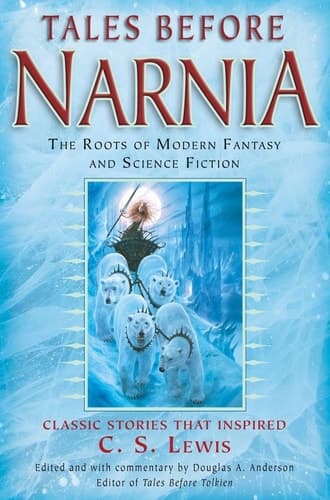
Tales Before Narnia: The Roots of Modern Fantasy and Science Fiction
J.R.R. TolkienPublished2008
Pages352
Formatpaperback
PublisherDel Rey
Synopsis
In his acclaimed collection Tales Before Tolkien, Douglas A. Anderson illuminated the sources, inspirations, and influences that fired J.R.R. Tolkien’s genius. Now Anderson turns his attention to Tolkien’s colleague and friend C. S. Lewis, whose influence on modern fantasy, through his beloved Narnia books, is second only to Tolkien’s own.
In many ways, Lewis’s influence has been even wider than Tolkien’s. For in addition to the Narnia series, Lewis wrote groundbreaking works of science fiction, urban fantasy, and religious allegory, and he came to be regarded as among the most important Christian writers of the twentieth century. It will come as no surprise, then, that such a wide-ranging talent drew inspiration from a variety of sources. Here are twenty of the tributaries that fed Lewis’s unique talent, among them:
“The Wood That Time Forgot: The Enchanted Wood,” taken from a never-before-published fantasy by Lewis’s biographer and friend, Roger Lancelyn Green, that directly inspired The Lion, the Witch, and the Wardrobe; E. Nesbit’s charming “The Aunt and Amabel,” in which a young girl enters another world by means of a wardrobe; “The Snow Queen,” by Hans Christian Andersen, featuring the abduction of a young boy by a woman as cruel as she is beautiful; and many more, including works by Charles Dickens, Kenneth Grahame, G. K. Chesterton, and George MacDonald, of whom Lewis would write, “I have never concealed the fact that I regarded him as my master.”
Full of fascinating insights into Lewis’s life and fiction, Tales Before Narnia is the kind of book that will be treasured by children and adults alike and passed down lovingly from generation to generation.
INCLUDING SEVENTEEN MORE WORKS BY THE PROGENITORS OF MODERN FANTASY AND SCIENCE FICTION:
“Tegnér’s Drapa” by Henry Wadsworth Longfellow
“The Magic Mirror” by George MacDonald
“Undine” by Friedrich de la Motte Fouqué
“Letters from Hell: Letter III” by Valdemar Thisted
“Fastosus and Avaro” by John Macgowan
“The Tapestried Chamber; or, The Lady in the Sacque” by Sir Walter Scott
“The Story of the Goblins Who Stole a Sexton” by Charles Dickens
“The Child and the Giant” by Owen Barfield
“A King’s Lesson” by William Morris
“The Waif Woman: A Cue—From a Saga” by Robert Louis Stevenson
“First Whisper of The Wind in the Willows” by Kenneth Grahame
“The Wish House” by Rudyard Kipling
“Et in Sempiternum Pereant” by Charles Williams
“The Dragon’s Visit” by J.R.R. Tolkien
“The Coloured Lands” by G. K. Chesterton
“The Man Who Lived Backwards” by Charles F. Hall
“The Dream Dust Factory” by William Lindsay Gresham
Recommendations
Generating recommendations…
Our AI is preparing recommendations for Tales Before Narnia: The Roots of Modern Fantasy and Science Fiction. This usually takes under a minute.
About J.R.R. Tolkien
J
J.R.R. Tolkien
1892–1973
John Ronald Reuel Tolkien (1892-1973) was a major scholar of the English language, specialising in Old and Middle English. Twice Professor of Anglo-Saxon (Old English) at the University of Oxford, he also wrote a number of stories, including most famously The Hobbit (1937) and The Lord of the Rings (1954-1955), which are set in a pre-historic era in an invented version of the world which he called by the Middle English name of Middle-earth. This was peopled by Men (and women), Elves, Dwarves, Trolls, Orcs (or Goblins) and of course Hobbits. He has regularly been condemned by the Eng. Lit. establishment, with honourable exceptions, but loved by literally millions of readers worldwide. In the 1960s he was taken up by many members of the nascent "counter-culture" largely because of his concern with environmental issues. In 1997 he came top of three British polls, organised respectively by Channel 4 / Waterstone's, the Folio Society, and SFX, the UK's leading science fiction media magazine, amongst discerning readers asked to vote for the greatest book of the 20th century. ([Source][1]) [1]: http://www.tolkiensociety.org/tolkien/biography.html
View author page