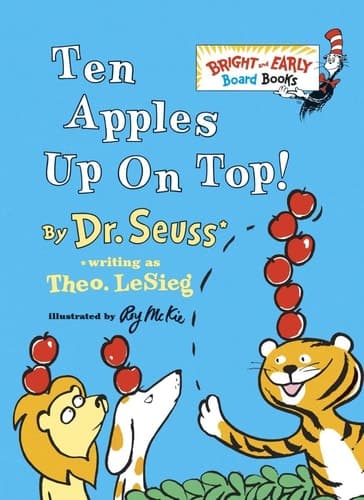
Ten Apples Up On Top!
Dr. SeussPublished1998
Pages24
FormatBoard book
PublisherRandom House Children's Books
Synopsis
Count your way through this silly stacking adventure with Dr. Seuss–now in a board book format perfect for the littlest of readers!
Don't let the apples drop! Three animal friends practice balancing apples on their heads in this hilarious introduction to counting. This hardcover picture book teaches all about numbers, with a dose of signature Seuss charm. Kids will learn to count to ten--and want to start all over again!
Bright and Early Board Books are super sturdy, simplified board book editions of classic Beginner Books. First launched in 1996, they have introduced millions of toddlers to beloved books from Dr. Seuss, P. D. Eastman, and other author-illustrators, in a format just right for young readers!
“Pretty much all the stuff you need to know is in Dr. Seuss.” –President Barack Obama
Recommendations
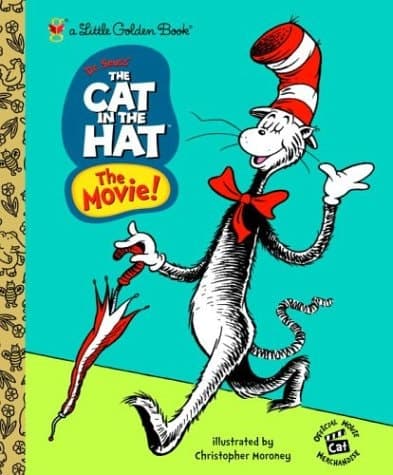
Dr. Seuss' The Cat in the Hat The Movie!
by Jesse Leon McCann
Wait—I know you just finished a Seuss book, but hear me out. This one has the same rhythmic counting and stacking chaos you loved, but with even more anarchic energy and a deeper narrative arc about consequences. The visual gags build on each other the way those apples do, creating that same satisfying escalation.
View book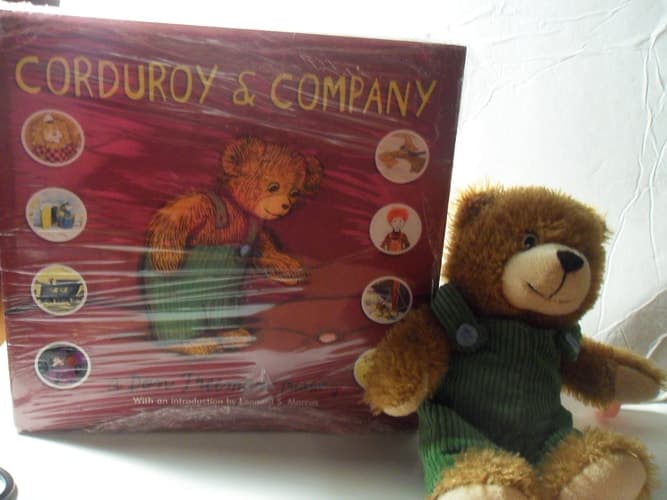
Corduroy & Company A Don Freeman Treasury
by Don Freeman
Freeman has that same gentle absurdism as Seuss—a toy bear searching for a button while balancing on department store shelves—but he adds genuine emotional stakes that sneak up on you. The illustrations have that same bouncy energy as Seuss's line work, and there's a quiet counting-down-to-resolution that mirrors your book's structure, just with more heart.
View book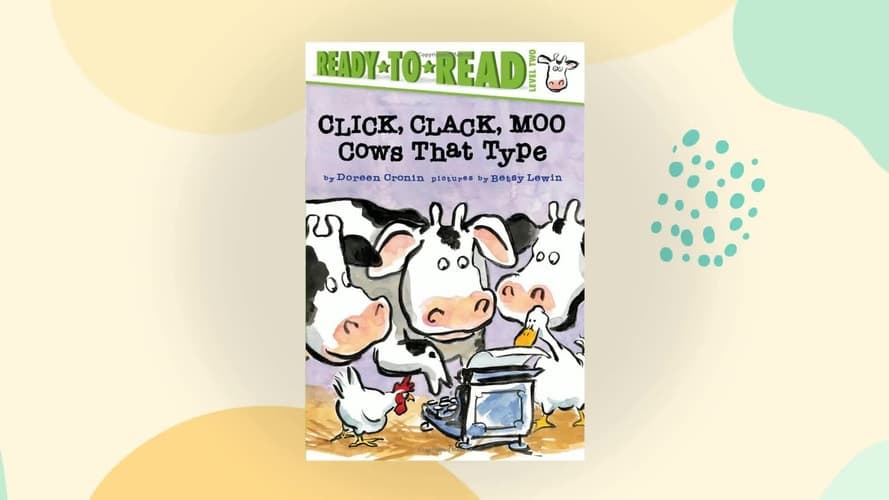
Click, Clack, Moo Cows that Type
by Doreen Cronin
Cronin writes with Seussian wordplay and rhythm—the title alone tells you that—but she layers in sly humor that works for both toddlers and adults reading aloud. There's the same physical comedy of things stacking and toppling, but with a farm full of scheming animals who've clearly read the same anarchist manifesto as the Cat in the Hat.
View book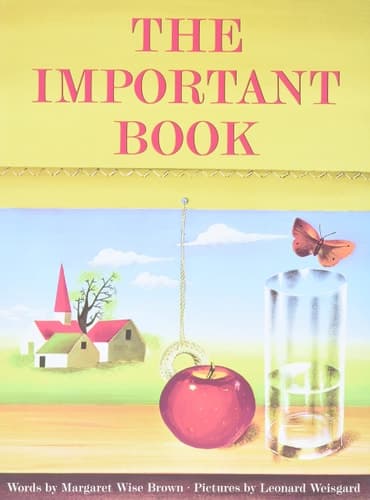
The Important Book
by Margaret Wise Brown
This one's from 1949—a different era entirely—but it shares that same meditative, repetitive structure with *Ten Apples*. Brown builds meaning through accumulation and rhythm, asking 'what matters most?' the way Seuss asks 'can you count to ten?' It's quieter, more philosophical, but equally hypnotic when read aloud.
View book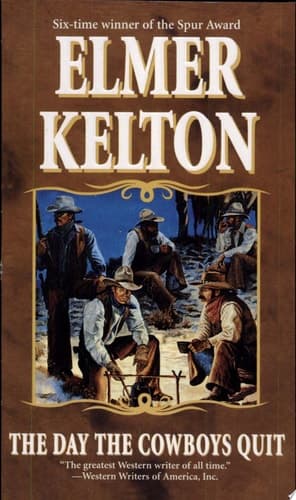
The Day the Cowboys Quit
by Elmer Kelton
Here's your surprise pick: this is technically a picture book about labor disputes and social commentary, but it's wrapped in the same slapstick energy and visual humor as *Ten Apples*. Each crayon's complaint builds on the last like apples on a head, and Daywalt uses color and typography the way Seuss uses rhythm—making the form of the book part of the joke itself.
View bookAbout Dr. Seuss
Theodor Seuss Geisel was born on in Springfield, Massachusetts to German-American parents. He attended public schools and then went to Dartmouth College, where he became editor of the Dartmouth _Jack-O-Lantern_. When he was barred from all extracurricular activities, he continued to write for the paper using the pseudonym "Seuss." After he graduated he became a contributor to the magazine The Judge, and began to sign his work as "Dr. Seuss." He attended Lincoln College, Oxford to earn a D.Phil in literature, but married Helen Palmer in 1927 and returned to the United States without earning the degree. He published humorous articles and illustrations in _The Judge_, _The Saturday Evening Post_, _Life_, _Vanity Fair_, and _Liberty_ and supported himself and his wife through the Great Depression with commercial illustrations for General Electric, NBC, Standard Oil, and many other companies. He also wrote and drew a short-lived comic strip called _Hejji_ in 1935. In 1937, returning from an ocean voyage to Europe, he wrote his first book, _And to Think That I Saw It on Mulberry Street_. When World War II began, he began to create political cartoons and became an editorial cartoonist for the left-wing New York City newspaper, _PM_. His political cartoons were later published in _Dr. Seuss Goes to War_. In 1942, he began producing propaganda posters for the Treasury Department and the War Production Board. In 1943, he joined the Animation Department of the First Motion Picture Unit of the U.S. Army Air Forces, where he wrote propaganda and training films. After the war, he and his wife moved to La Jolla, California. He returning to writing and illustrating children's books. In 1954, _Life_ magazine published an article on the dullness of children's books, and Geisel was inspired to write _The Cat in the Hat_. In 1967, his wife Helen committed suicide. He married Audrey Stone Dimond in 1968. Geisel died in La Jolla, California in 1991. Over the course of his career, Geisel wrote over 60 children's books, either under the pseudonym "Dr. Seuss" for the ones he wrote and illustrated himself, "Theo. LeSieg" for books he wrote but others illustrated, or "Rosetta Stone" for _Because a Little Bug Went Ka-choo_ (1975). He also wrote two books for adults: _The Seven Lady Godivas_; _Oh, The Places You'll Go!_; and _You're Only Old Once_.
View author page