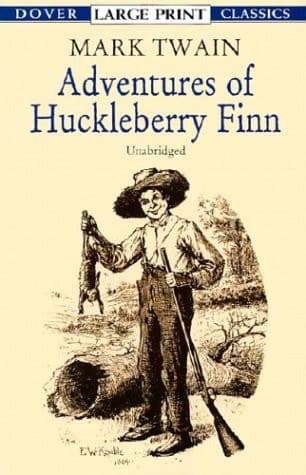
The Adventures of Huckleberry Finn
Mark TwainPublished2001
Pages338
Formatpaperback
PublisherDover Publications, Incorporated
Synopsis
Referring to Adventures of Huckleberry Finn, H. L. Mencken noted that his discovery of this classic American novel was "the most stupendous event of my whole life"; Ernest Hemingway declared that "all modern American literature stems from this one book," while T. S. Eliot called Huck "one of the permanent symbolic figures of fiction, not unworthy to take a place with Ulysses, Faust, Don Quixote, Don Juan, Hamlet."
The novel's preeminence derives from its wonderfully imaginative re-creation of boyhood adventures along the mighty Mississippi River, its inspired characterization, the author's remarkable ear for dialogue, and the book's understated development of serious underlying themes: "natural" man versus "civilized" society, the evils of slavery, the innate value and dignity of human beings, the stultifying effects of convention, and other topics. But most of all, Adventures of Huckleberry Finn is a wonderful story―filled with high adventure and unforgettable characters (including the great river itself)―that no one who has read it will ever forget.
Unabridged Dover (1994) republication of the text of the first American edition, published by Charles L. Webster and Company, New York, 1885. New introductory Note.
Recommendations
Generating recommendations…
Our AI is preparing recommendations for The Adventures of Huckleberry Finn. This usually takes under a minute.
About Mark Twain
M
Mark Twain
1835–1910
Mark Twain, born Samuel Langhorne Clemens, was a prolific American author and humorist. Twain is best known for his novels Adventures of Huckleberry Finn (1884), which has been called "the Great American Novel", and The Adventures of Tom Sawyer (1876). He is extensively quoted. Twain was a friend to presidents, artists, industrialists, and European royalty. ([Source][1].) [1]:http://en.wikipedia.org/wiki/Mark_Twain
View author page