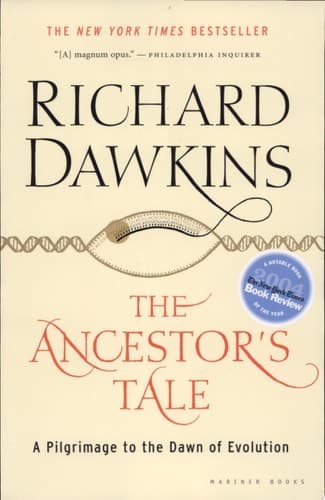
The Ancestor's Tale A Pilgrimage to the Dawn of Evolution
Richard DawkinsPublished2004
Pages673
Formatpaperback
PublisherHoughton Mifflin Harcourt
Synopsis
The renowned biologist and thinker Richard Dawkins presents his most expansive work yet: a comprehensive look at evolution, ranging from the latest developments in the field to his own provocative views. Loosely based on the form of Chaucer's Canterbury Tales, Dawkins's Tale takes us modern humans back through four billion years of life on our planet. As the pilgrimage progresses, we join with other organisms at the forty "rendezvous points" where we find a common ancestor. The band of pilgrims swells into a vast crowd as we join first with other primates, then with other mammals, and so on back to the first primordial organism. Dawkins's brilliant, inventive approach allows us to view the connections between ourselves and all other life in a bracingly novel way. It also lets him shed bright new light on the most compelling aspects of evolutionary history and theory: sexual selection, speciation, convergent evolution, extinction, genetics, plate tectonics, geographical dispersal, and more. The Ancestor's Tale is at once a far-reaching survey of the latest, best thinking on biology and a fascinating history of life on Earth. Here Dawkins shows us how remarkable we are, how astonishing our history, and how intimate our relationship with the rest of the living world.
Recommendations
Generating recommendations…
Our AI is preparing recommendations for The Ancestor's Tale A Pilgrimage to the Dawn of Evolution. This usually takes under a minute.
About Richard Dawkins
R
Richard Dawkins
Born 1941
Clinton Richard Dawkins, FRS, FRSL is a British ethologist, evolutionary biologist and popular science author. He was formerly Professor for Public Understanding of Science at Oxford and was a fellow of New College, Oxford. Dawkins came to prominence with his 1976 book *The Selfish Gene*, which popularised the gene-centred view of evolution and introduced the term meme. In 1982, he made a widely cited contribution to evolutionary biology with the concept, presented in his book *The Extended Phenotype*, that the phenotypic effects of a gene are not necessarily limited to an organism's body, but can stretch far into the environment, including the bodies of other organisms. Dawkins is well known for his candid criticism of creationism and intelligent design. In his 1986 book *The Blind Watchmaker*, he argued against the watchmaker analogy, an argument for the existence of a supernatural creator based upon the complexity of living organisms. Instead, he described evolutionary processes as analogous to a blind watchmaker. He has since written several popular science books, and makes regular television and radio appearances, predominantly discussing these topics. ([Source][1]) [1]: http://en.wikipedia.org/wiki/Richard_Dawkins
View author page