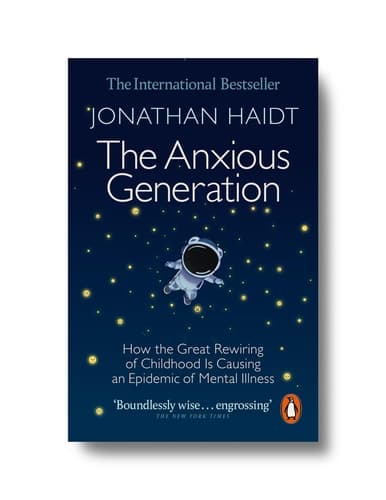
The Anxious Generation How the Great Rewiring of Childhood Is Causing an Epidemic of Mental Illness
Jonathan HaidtPublished2025
Pages464
Formatpaperback
PublisherPenguin Publishing Group
Synopsis
Jonathan Haidt has spent his career speaking truth and wisdom in some of the most difficult spaces - communities polarized by politics and religion, campuses battling culture wars, and now the mental health emergency hitting teenagers today in many countries around the world.
In The Anxious Generation, Haidt shows how, between 2010 and 2015, childhood and adolescence got rewired. As teens traded in their flip phones for smartphones packed with social media apps, time online soared, including time spent comparing oneself to a vast pool of others. Time engaging face-to-face with friends and family plummeted, and so did mental health.
But this is not just a story about technology; this profound shift took place against a backdrop of declining childhood freedom and free-play, as parents over-supervised every aspect of their children's lives offline, depriving them of the experiences they most need to become strong and self-governing adults.
In this book, Haidt makes a compelling argument that the loss of play-based childhood and its replacement with a phone-based childhood that is not suitable for human development is the source of increased mental distress among teenagers. The Anxious Generation delves into the latest psychological and biological research to show the four fundamental ways in which a phone-based childhood disrupts development - sleep deprivation, social deprivation, cognitive fragmentation and addiction. Haidt offers separate in-depth analyses of what has happened to girls, and what has happened to boys, offering practical advice for parents, schools, governments, and teens themselves. Drawing on ancient wisdom and cutting-edge research, this eye-opening book is a life raft and a powerful call-to-arms.
Recommendations

The Rise and Fall of American Public Schools: The Political Economy of Public Education in the Twentieth Century
by Robert J. Franciosi
Gordon does for economic history what Haidt does for developmental psychology—he challenges the assumption that progress is linear and inevitable. His meticulous data work on how technological change actually affects human flourishing (spoiler: not always positively) gives you the historical scaffolding to understand why the smartphone revolution landed so differently than previous innovations. It's the macro-level complement to Haidt's micro-level observations about what went wrong.
View book
Quilting and Braiding The Feminist Christologies of Sallie McFague and Elizabeth A. Johnson in Conversation
by Shannon Schrein
Where Haidt diagnoses the problem, Kimmerer offers a different framework entirely—one rooted in reciprocal relationships rather than optimization. Her essays on how Indigenous cultures understood child development, community interdependence, and our relationship with the natural world provide the philosophical counterweight to Haidt's argument about what children actually need. It's not a direct rebuttal but a profound alternative vision of human flourishing.
View book
The Last Lovely City: Stories
by Alice Adams
Laing traces loneliness through 20th-century art and artists in ways that feel like a conversation with Haidt's concerns about social deprivation, but she's asking a trickier question: what's the difference between solitude and loneliness, and can we actually design our way out of disconnection? Her lyrical, essayistic approach offers something Haidt's research-heavy style doesn't—the felt experience of isolation, which might resonate with why the statistics in *The Anxious Generation* matter so much.
View book
The Nurture Assumption Why Children Turn Out the Way They Do
by Judith Rich Harris
Published in 1998, Harris challenges the parental-influence orthodoxy that Haidt partially endorses, arguing that peer groups matter far more than parents realize—which makes for productive disagreement with *The Anxious Generation*. She's rigorous with her evidence while reaching conclusions that feel counterintuitive, and reading her alongside Haidt will sharpen your thinking about what actually shapes adolescent development versus what we assume does.
View bookAbout Jonathan Haidt
J
Jonathan Haidt
Born 1963
Jonathan David Haidt (/haɪt/; born October 19, 1963) is an American social psychologist, Professor of Ethical Leadership at New York University Stern School of Business,[1] and author. His main areas of study are the psychology of morality and moral emotions. Haidt's main scientific contributions come from the psychological field of moral foundations theory,[2] which attempts to explain the evolutionary origins of human moral reasoning on the basis of innate, gut feelings rather than logical reason.[3] The theory was later extended to explain the different moral reasoning and how they relate to political ideology, with different political orientations prioritizing different sets of morals.[4] The research served as a foundation for future books on various topics. Haidt has written three books for general audiences, including: The Happiness Hypothesis: Finding Modern Truth in Ancient Wisdom (2006) explores the relationship between ancient philosophies and modern science;[5] The Righteous Mind: Why Good People are Divided by Politics and Religion (2012) examines how morality is shaped by emotion and intuition more than by reasoning, and why differing political groups have different notions of right and wrong;[6] and The Coddling of the American Mind: How Good Intentions and Bad Ideas Are Setting Up a Generation for Failure (2018), co-written with Greg Lukianoff, explores the rising political polarization and changing culture on college campuses, and its effects on mental health. Haidt has attracted both support and criticism for his critique of the current state of universities and his interpretation of progressive values.[7] He has been named one of the "top global thinkers" by Foreign Policy magazine, and one of the "top world thinkers" by Prospect magazine.[8][9] He is among the most cited researchers in political and moral psychology, and is considered among the top 25 most influential living psychologists
View author page