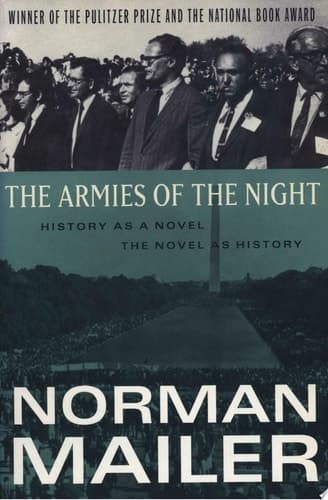
The Armies of the Night History as a Novel, the Novel as History (Pulitzer Prize and National Book Award Winner)
Norman MailerPublished1995
Pages304
Formatpaperback
PublisherPenguin
Synopsis
Winner of the Pulitzer Prize and the National Book Award
With a Introduction by Adam Gopnik
Fifty years after the March on the Pentagon, Norman Mailer’s seminal tour de force remains as urgent and incisive as ever. Winner of America’s two highest literary awards, The Armies of the Night uniquely and unforgettably captures the Sixties’ tidal wave of love and rage at its crest and a towering genius at his peak.
The time is October 21, 1967. The place is Washington, D.C. Depending on the paper you read, 20,000 to 200,000 protestors are marching to end the war in Vietnam, while helicopters hover overhead and federal marshals and soldiers with fixed bayonets await them on the Pentagon steps. Among the marchers is a writer named Norman Mailer. From his own singular participation in the day’s events and his even more extraordinary perceptions comes a classic work that shatters the mold of traditional reportage. Intellectuals and hippies, clergymen and cops, poets and army MPs crowd the pages of a book in which facts are fused with techniques of fiction to create the nerve-end reality of experiential truth.
“[Mailer’s] genuine wit and bellicose charm, and his fervent and intense sense of legitimately caring, render The Armies of the Night an artful document, worthy to be judged as literature.”—Time
“Only a born novelist could have written a piece of history so intelligent, mischievous, penetrating and alive.”—Alfred Kazin, The New York Times Book Review
Recommendations
Generating recommendations…
Our AI is preparing recommendations for The Armies of the Night History as a Novel, the Novel as History (Pulitzer Prize and National Book Award Winner). This usually takes under a minute.
About Norman Mailer
N
Norman Mailer
1923–2007
Norman Kingsley Mailer was an American novelist, journalist, essayist, poet, playwright, screenwriter and film director. Along with Truman Capote, Joan Didion, Hunter S. Thompson, John McPhee, and Tom Wolfe, Mailer is considered an innovator of narrative nonfiction, a genre sometimes called New Journalism, which superimposes the essay onto the nonfiction novel. He was awarded the Pulitzer Prize twice and the National Book Award once. In 1955, Mailer, together with Ed Fancher and Dan Wolf, first published The Village Voice, which began as an arts and politics oriented weekly newspaper distributed in Greenwich Village. In 2005, he won the Medal for Distinguished Contribution to American Letters from the National Book Foundation. ([Source][1]) [1]: http://en.wikipedia.org/wiki/Norman_Mailer
View author page