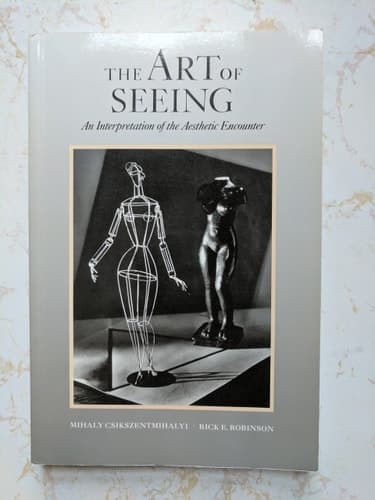
The Art of Seeing An Interpretation of the Aesthetic Encounter
Mihaly CsikszentmihalyiPublished1990
Pages203
Formatpaperback
PublisherGetty Publications
Synopsis
This study attempts to gain information concerning the receptive, as opposed to the creative, aesthetic experience by talking to museum professionals who spend their working lives identifying, appraising, and explicating works of art. The study is based on an underlying assumption that rules and practices for looking at art exist and must be mastered if success is to ensue. The anthropological research approach uses semi-structured interviews and subjects the responses to systematic analysis. Major conclusions emphasize the unity and diversity of the aesthetic experience. The structure of the aesthetic experience is found to be an intense involvement of attention in response to a visual stimulus, for no other reason than to sustain the interaction. The experiential consequences of such a deep and autotelic involvement are an intense enjoyment characterized by feelings of personal wholeness, a sense of discovery, and a sense of human connectedness. The aesthetic content requires two sets of preconditions that make the experience possible: the challenges contained in the object and the skills of the viewer. While the structure of the aesthetic experience is rated similar in terms by all the respondents, the challenges, or content stimuli that triggers the experience vary considerably. These challenges of art are the formal structure of the work, its emotional impact, the intellectual references it carries, and the opportunities it creates for a dialogue among the artist, his time, and the viewer. Without this content challenge there would be nothing to arrest the viewer, and consequently no experience. Level of skill is critical. Challenges and skill must be nearly in balance for the attention to become focused. A complex work of art will engage only a person who has developed complex visual skills. The book is divided into six chapters and concludes with appendices. "Interview Questions for Museum Professionals" and "Aesthetic Experience Questionnaire Form." Contains approximately 100 references. (MM)
Recommendations
Generating recommendations…
Our AI is preparing recommendations for The Art of Seeing An Interpretation of the Aesthetic Encounter. This usually takes under a minute.
About Mihaly Csikszentmihalyi
M
Mihaly Csikszentmihalyi
1934–2021
Hungarian psychologist Mihaly Csikszentmihalyi was the Distinguished Professor of Psychology and Management at Claremont Graduate University. He is noted for his work in the study of happiness and creativity, but is best known as the architect of the notion of flow, a highly focused mental state. Martin Seligman, former president of the American Psychological Association, described Csikszentmihalyi as the world's leading researcher on positive psychology. Csikszentmihalyi once said: "Repression is not the way to virtue. When people restrain themselves out of fear, their lives are by necessity diminished. Only through freely chosen discipline can life be enjoyed and still kept within the bounds of reason." (Wikipedia)
View author page