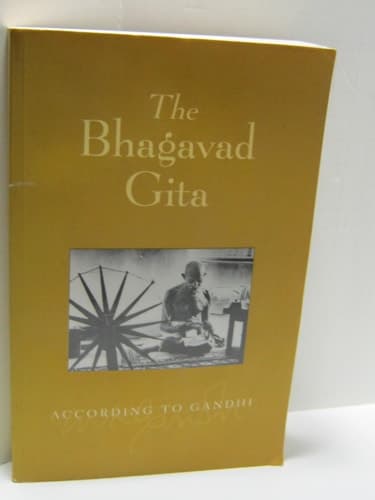
The Bhagavad Gita According to Gandhi
Mahatma GandhiPublished2000
Pages245
Formatpaperback
PublisherBerkeley Hills Books
Synopsis
This is the first volume in any language to include Gandhi's Gita text and commentary together in their entirety. Presented to his disciples at prayer meetings over a nine-month period in 1926, Mahatma Gandhi's commentaries on the Gita are regarded in India as among the most important of the century. In them Gandhi addresses the issues he felt most directly affected the spiritual lives of common people.
Recommendations
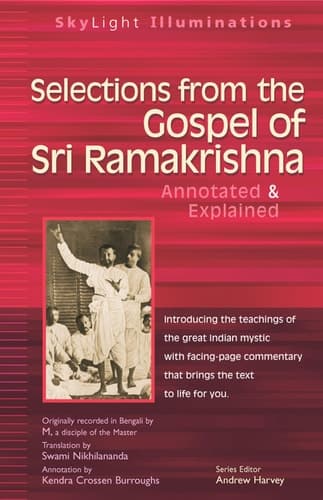
Selections from the Gospel of Sri Ramakrishna : Annotated & Explained
by Ramakrishna
Like Gandhi's Gita commentaries, this is a collection of teachings delivered orally to disciples, capturing a spiritual master's responses to everyday questions about faith and practice. Where Gandhi emphasizes action and duty, Ramakrishna explores the interior landscape of devotion—together they'd give you a fuller picture of how different Hindu teachers addressed the spiritual needs of ordinary people in their own eras.
View book
Alex Haley's The Autobiography of Malcolm X
by Anita J. Aboulafia
This is my surprise pick for you: while it's not explicitly spiritual philosophy, Malcolm X's journey parallels Gandhi's in unexpected ways—both men grapple publicly with how to interpret sacred texts through the lens of social justice, and both ultimately arrive at positions that challenge their own communities' assumptions. The raw, conversational tone of Haley's transcription captures something similar to how Gandhi's prayer-meeting commentaries feel intimate and unpolished.
View book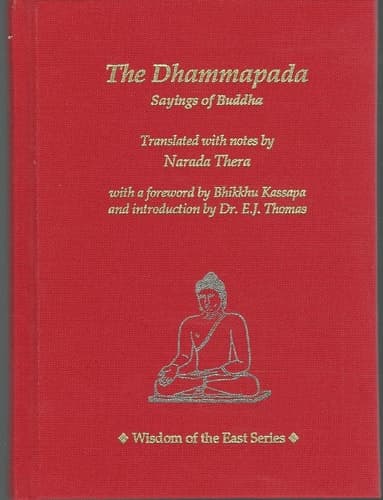
The Dhammapada Sayings of Buddha
by Narada Thera
Easwaran's approach to Buddhist teachings mirrors Gandhi's method—he's not offering academic distance but rather a practitioner's commentary aimed at helping modern readers apply ancient wisdom to their lives. You'll notice how both texts treat spiritual practice as inseparable from ethics and daily conduct, rather than as something separate from the world.
View book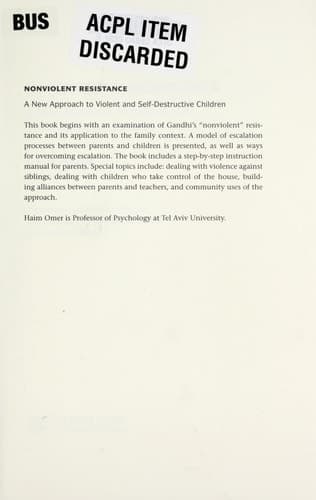
Non-Violent Resistance A New Approach to Violent and Self-destructive Children
by Haim Omer
De Ligt, a Dutch anarchist and contemporary of Gandhi, develops a philosophical framework for nonviolence that complements Gandhi's Gita interpretation from a completely different cultural and political angle. Reading them together shows you how the principle of ahimsa resonated across continents—this is a lesser-known text that deserves more attention and will deepen your understanding of Gandhi's ideas by showing their broader intellectual context.
View book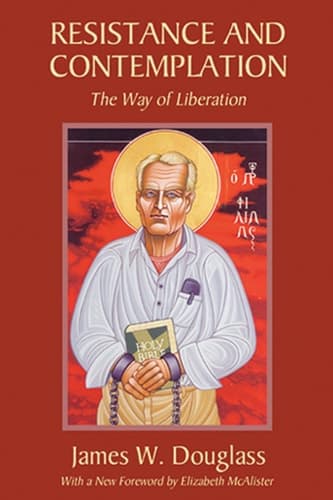
Resistance and Contemplation The Way of Liberation
by James W. Douglass
Adyashanti writes for contemporary seekers the way Gandhi wrote for his 1926 prayer-meeting disciples—addressing real spiritual obstacles people actually face rather than abstract theology. His emphasis on direct experience and questioning authority (even spiritual authority) echoes Gandhi's insistence that readers engage critically with the Gita rather than accept it passively, making this a natural bridge from classical commentary to modern practice.
View bookAbout Mahatma Gandhi
M
Mahatma Gandhi
1869–1948
Mohandas Karamchand Gandhi, known as Mahatma Gandhi, was a pre-eminent political and spiritual leader of India and the Indian independence movement. * [Works by Mohandas Karamchand Gandhi](http://www.wikilivres.info/wiki/Mohandas_K._Gandhi) French, English * [Works by Mohandas Karamchand Gandhi](http://en.wikisource.org/wiki/Author:Mohandas_K._Gandhi) English * [Œuvres de Mohandas Karamchand Gandhi](http://fr.wikisource.org/wiki/Mohandas_K._Gandhi) French
View author page