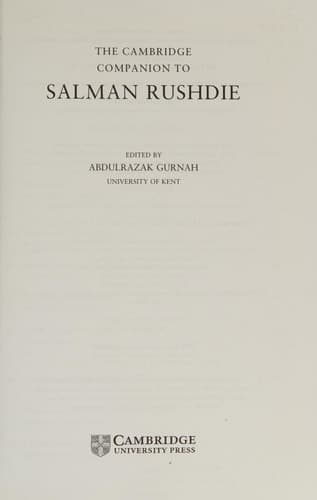
The Cambridge Companion to Salman Rushdie
Abdulrazak GurnahPublished2007
Pages218
Formathardcover
PublisherCambridge University Press
Synopsis
Rushdie is a major contemporary writer, who engages with some of the vital issues of our times: migrancy, postcolonialism, religious authoritarianism. This Companion offers a comprehensive introduction to his entire oeuvre. Part I provides thematic readings of Rushdie and his work, with chapters on how Bollywood films are intertextual with the fiction, the place of family and gender in the work, the influence of English writing and reflections on the fatwa. Part II discusses Rushdie's importance for postcolonial writing and provides detailed interpretations of his fiction. In one volume, this book provides a stimulating introduction to the author and his work in a range of expert essays and readings. With its detailed chronology of Rushdie's life and a comprehensive bibliography of further reading, this volume will be invaluable to undergraduates studying Rushdie and to the general reader interested in his work.
Recommendations
Generating recommendations…
Our AI is preparing recommendations for The Cambridge Companion to Salman Rushdie. This usually takes under a minute.
About Abdulrazak Gurnah
A
Abdulrazak Gurnah
Born 1948
**Abdulrazak Gurnah** FRSL (born 20 December 1948) is a Tanzanian-born British novelist and academic. He was born in the Sultanate of Zanzibar and moved to the United Kingdom in the 1960s as a refugee during the Zanzibar Revolution. His novels include Paradise (1994), which was shortlisted for both the Booker and the Whitbread Prize; Desertion (2005); and By the Sea (2001), which was longlisted for the Booker and shortlisted for the Los Angeles Times Book Prize. Gurnah was awarded the 2021 Nobel Prize in Literature "for his uncompromising and compassionate penetration of the effects of colonialism and the fates of the refugee in the gulf between cultures and continents". He is Emeritus Professor of English and Postcolonial Literatures at the University of Kent. [source](https://en.wikipedia.org/wiki/Abdulrazak_Gurnah)
View author page