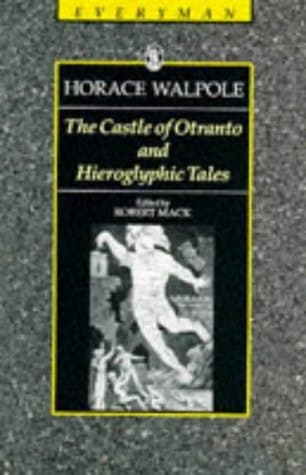
The Castle of Otranto and Hieroglyphic Tales
Horace WalpolePublished1993
Pages164
Formatpaperback
PublisherDent
Synopsis
Supernatural terror, crimes of passion, a wronged heir restored: these are the ingredients in Walpole's work, often called the first "gothic" novel. Jealous passion leads to murder, ghostly incarnations and desperate pursuits - before Manfred, false Prince of Otranto, is exposed and order is finally restored to the land. The castle of Otranto is at once a horror story, a mystery and a parody; it is also a tantalisingly autobiographical work in which Walpole expressed his deepest desires and anxieties. Presenting the finest writing of one of England's most witty and perceptive social critics, this volume also includes Walpole's hieroglyhpic tales, a collection of surrealistic and eerily modern fables.
Recommendations
Generating recommendations…
Our AI is preparing recommendations for The Castle of Otranto and Hieroglyphic Tales. This usually takes under a minute.
About Horace Walpole
H
Horace Walpole
1717–1797
Horatio Walpole, 4th Earl of Orford (24 September 1717 – 2 March 1797), also known as Horace Walpole, was an English writer, art historian, man of letters, antiquarian and Whig politician. He had Strawberry Hill House built in Twickenham, south-west London, reviving the Gothic style some decades before his Victorian successors. His literary reputation rests on the first Gothic novel, *The Castle of Otranto* (1764), and his Letters, which are of significant social and political interest. They have been published by Yale University Press in 48 volumes. He was the son of the first British Prime Minister, Sir Robert Walpole. As Horace Walpole was childless, on his death his barony of Walpole descended to his cousin of the same surname, who was created the new Earl of Orford. **Source**: [Horace Walpole](https://en.wikipedia.org/wiki/Horace_Walpole) on Wikipedia.
View author page