Synopsis
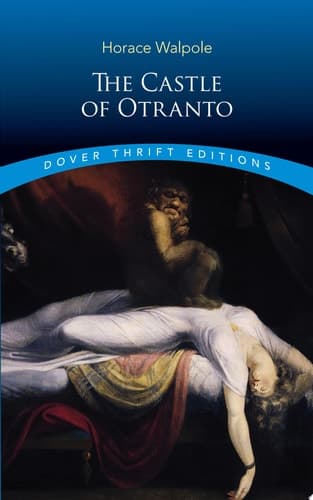
In a faraway medieval realm, Manfred, an arrogant and evil prince, rules with an iron fist. Banishing his wife to the castle dungeon, he confines — and plans to wed — the lovely Isabella, fiancée of his recently deceased son. The prince's plans are foiled, however, when a well-meaning peasant helps the young woman escape through the castle's underground passages. Grisly, supernatural events further aid in fulfilling a prophecy that spells doom for the prince and justice for Isabella's rescuer and rightful heir to the throne.
One of the first and greatest of Gothic novels, this thrilling tale ranks among the most influential books in literary history. Serving as the model for plots, characterizations, settings, and tone for hundreds of successors, The Castle of Otranto abounds with colorful scenes, adventure, suspense, and inexplicable phenomena.
Recommendations
Generating recommendations…
Our AI is preparing recommendations for The Castle of Otranto. This usually takes under a minute.
About Horace Walpole
H
Horace Walpole
1717–1797
Horatio Walpole, 4th Earl of Orford (24 September 1717 – 2 March 1797), also known as Horace Walpole, was an English writer, art historian, man of letters, antiquarian and Whig politician. He had Strawberry Hill House built in Twickenham, south-west London, reviving the Gothic style some decades before his Victorian successors. His literary reputation rests on the first Gothic novel, *The Castle of Otranto* (1764), and his Letters, which are of significant social and political interest. They have been published by Yale University Press in 48 volumes. He was the son of the first British Prime Minister, Sir Robert Walpole. As Horace Walpole was childless, on his death his barony of Walpole descended to his cousin of the same surname, who was created the new Earl of Orford. **Source**: [Horace Walpole](https://en.wikipedia.org/wiki/Horace_Walpole) on Wikipedia.
View author page