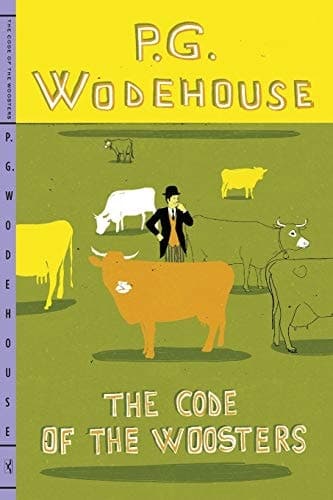
The Code of the Woosters
Pelham Grenville WodehousePublished2011
Pages272
Formatpaperback
PublisherW. W. Norton
Synopsis
Nothing but trouble can ensue when Bertie Wooster's Aunt Dahlia instructs him to steal a silver jug from Totleigh Towers, home of magistrate and hell-hound, Sir Watkyn Bassett. First he must face the peril of Sir Watkyn's droopy daughter, Madeline, and then the terrors of would-be Dictator, Roderick Spode and his gang of Black Shorts. But when duty calls, Bertram answers, and so there follows what he himself calls the "sinister affair of Gussie Fink-Nottle, Madeline Bassett, old Pop Bassett, Stiffy Byng, the Rev. H.P. ('Stinker') Pinker, the eighteenth-century cow-creamer and the small, brown, leather-covered notebook." In a plot with more twists than an English country lane, it takes all the ingenuity of Jeeves to extract his master from the soup again. - Jacket.
Recommendations
Generating recommendations…
Our AI is preparing recommendations for The Code of the Woosters. This usually takes under a minute.
About Pelham Grenville Wodehouse
P
Pelham Grenville Wodehouse
1881–1975
Sir Pelham Grenville Wodehouse, KBE (15 October 1881 – 14 February 1975) (pronounced /ˈwʊdhaʊs/) was an English humorist, whose body of work includes novels, short stories, plays, poems, song lyrics, and numerous pieces of journalism. He enjoyed enormous popular success during a career of more than seventy years and his many writings continue to be widely read. Despite the political and social upheavals that occurred during his life, much of which was spent in France and the United States, Wodehouse's main canvas remained that of pre-war English upper-class society, reflecting his birth, education, and youthful writing career. An acknowledged master of English prose, Wodehouse has been admired both by contemporaries such as Hilaire Belloc, Evelyn Waugh and Rudyard Kipling and by modern writers such as Stephen Fry, Douglas Adams, Salman Rushdie, Zadie Smith and Terry Pratchett. Journalist and writer Christopher Hitchens commented, "there is not, and never will be, anything to touch him." Wodehouse's characters are often eccentric, with peculiar attachments, such as to pigs (Lord Emsworth), newts (Gussie Fink-Nottle), antique silver (Bertie's Uncle Tom Travers), golf-collectables (numerous characters) or socks (Archibald Mulliner). His "mentally negligible" good-natured characters invariably make their lot worse by their half-witted schemes to improve a bad situation. A key figure in most Wodehouse stories is a "fixer" whose genius soars above the incompetent blather and crude bluster of most of the other characters, Jeeves being the best known example. Other characters in this vein are Lord Ickenham ("Uncle Fred") and Galahad Threepwood, who perform much the same role in the Blandings Castle stories—though never both at the same time—and Psmith, who does the same thing in the stories that bear his name. Wodehouse was known for his consummate skill at their detailed construction and development. Typically, a relative or friend makes some demand that forces a character into a bizarre situation from which it seems impossible to recover, only to resolve itself in a clever and satisfying finale. Source: Wikipedia [http://en.wikipedia.org/wiki/P._G._Wodehouse]
View author page