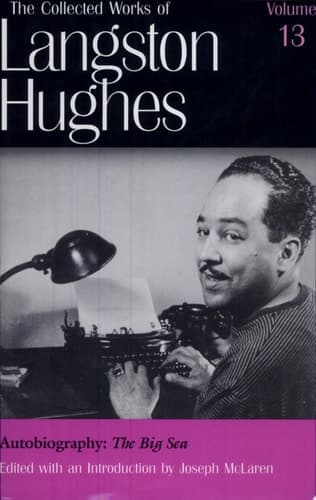
The Collected Works of Langston Hughes
Langston HughesPublished2001
Pages268
Formathardcover
PublisherUniversity of Missouri Press
Synopsis
Langston Hughes was among the Harlem Renaissance authors who traveled widely during the 1920s. In the first volume of his autobiography, The Big Sea, covering the years through 1931, Hughes offers recollections of his childhood in Kansas, his high school years in Cleveland, his sojourn with his father in Mexico, and his initial reactions to New York City and Harlem.
Commentaries on the "Black Renaissance" in Harlem and Washington, D.C., are intertwined with recollections of his student years at Lincoln University in Pennsylvania, his travels through the South, and his association as a "younger generation" poet with the New York and Harlem literary establishment represented by the magazines Crisis and Opportunity. Personal memories of Jessie Fauset, Countee Cullen, Jean Toomer, W. E. B. Du Bois, Wallace Thurman, Alain Locke, Carter G. Woodson, Vachel Lindsay, A'Lelia Walker, and others are augmented by allusions to such celebrities as Duke Ellington, Florence Mills, Eubie Blake, Florence Embry, Josephine Baker, Bert Williams, Theodore Dreiser, Ethel Barrymore, and Bessie Smith.
Hughes addresses such controversial issues as his literary and personal disagreements with Zora Neale Hurston over their play Mule Bone, Carl Van Vechten's problematic novel Nigger Heaven, racial matters at Lincoln University, the Jim Crow laws in the South, and the failures of white patronage. Furthermore, Hughes refers to the sources of a blues poetry aesthetic, his visit to Cuba, and the struggle to complete his first novel, Not without Laughter. A rare autobiographical presentation of the Harlem Renaissance from the perspective of an insider, The Big Sea is a veritable catalog of notables. In addition, it offers a "black perspective" on the expatriate life in Europe during the Jazz Age.
Recommendations
Generating recommendations…
Our AI is preparing recommendations for The Collected Works of Langston Hughes. This usually takes under a minute.
About Langston Hughes
L
Langston Hughes
1902–1967
Langston Hughes (1902-1967) Writer, editor, lecturer Langston Hughes achieved fame as a poet during the burgeoning of the arts known as the Harlem Renaissance, but those who label him "a Harlem Renaissance poet" have restricted his fame to only one genre and decade. In addition to his work as a poet, Hughes was a novelist, columnist, playwright, and essayist, and though he is most closely associated with Harlem, his world travels influenced his writing in a profound way. Langston Hughes followed the example of Paul Laurence Dunbar, one of his early poetic influences, to become the second African American to earn a living as a writer. His long and distinguished career produced volumes of diverse genres and inspired the work of countless other African American writers. --From Gale Cengage Learning Free resources
View author page