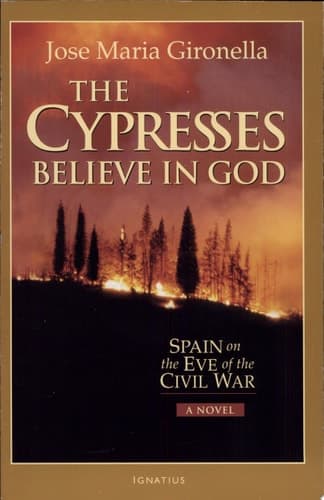
The Cypresses Believe in God
José María GironellaPublished2005
Pages806
Formatpaperback
PublisherIgnatius Press
Synopsis
Considered by many critics to be the greatest novel about the Spanish Civil War, this classic work by Spaniard Jose Maria Gironella is an unbiased account of the complicated events, movements and personalities that led up to the war. Beginning in 1931, Cypresses covers the next five years of political unrest, culminating in the explosion of the brutal war that wreaked such great havoc on Spain and its citizens. In his epic novel, both gripping and suspenseful, Gironella deftly portrays the human conflict, both internal and external. The most influential philosophical movements of the 20th century are embodied in various characters. Through them, the reader is introduced to every faction involved--ancharist, communist, Catholic, royalist, existentialist, and others.
Recommendations
And Quiet Flows the Don
by Mikhail Aleksandrovich Sholokhov
Like Gironella, Sholokhov uses a sprawling family saga to capture the ideological fracturing of a nation during revolutionary upheaval—here, the Russian Civil War through the eyes of Cossack characters caught between competing worldviews. Both novels refuse easy moral judgments, instead letting readers experience how ordinary people navigate impossible historical moments, and both are considered definitive accounts of their respective conflicts by literary scholars.
View book
The Apocalyptic Vision of Mikhail Bulgakov's the Master and Margarita (Studies in Slavic Language & Literature)
by Edward E. Ericson
This 1960s Soviet masterpiece shares Gironella's fascination with how political ideology corrupts human relationships and individual conscience, but Bulgakov deploys magical realism and dark satire where Gironella uses realism—making it a surprise recommendation that still grapples with totalitarianism, faith, and artistic integrity. The novel's structure mirrors how Gironella weaves multiple philosophical positions into his narrative, except Bulgakov lets the absurdity speak louder than the argument.
View book
Danzig Trilogy of Gunter Grass A Study of the Tin Drum, Cat and Mouse, and Dog Years
by John Reddick
Grass's German masterpiece covers similar ideological ground to Cypresses—the rise of fascism, competing political movements, the corruption of ordinary life by historical forces—but tells it through the deliberately unreliable perspective of a character who refuses to grow up. Where Gironella gives you multiple factions fairly, Grass makes you experience how propaganda and ideology warp individual perception itself, offering a complementary rather than repetitive exploration of how societies fracture.
View book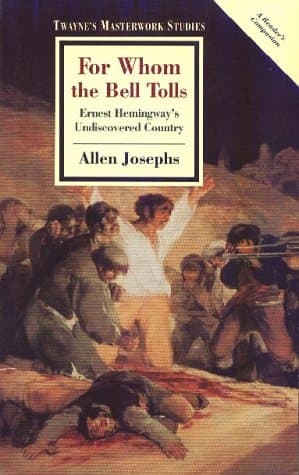
For Whom the Bell Tolls: Ernest Hemingway's Undiscovered Country (Twayne's Masterwork Studies)
by Allen Josephs
I know this seems obvious, but Hemingway's novel actually works differently than Gironella's—where Gironella builds a panoramic view of Spanish society before the war, Hemingway narrows focus to a single bridge and a few days during the conflict, using compression and understatement to achieve what Gironella achieves through breadth. If you want to see how two major writers approached the same historical moment from opposite structural angles, this pairing is revelatory.
View bookAbout José María Gironella
J
José María Gironella
1917–2003
José María Gironella Pous (Darníus, Gerona, 31 de diciembre de 1917-Arenys de Mar, Barcelona, 3 de enero de 2003) fue un escritor español, ganador del premio Nadal, el Planeta, el Nacional de Literatura y el Ateneo de Sevilla. Le hizo célebre su trilogía sobre la guerra civil española: *Los cipreses creen en Dios* (1953), *Un millón de muertos* (1961) y *Ha estallado la paz* (1966). José María Gironella Pous (Darníus, Gerona, 31 December 1917–Arenys de Mar, Barcelona, 3 January 2003) was a Spanish writer and winner of the Nadal, Planeta, National Literature and Seville Athenaeum awards. He became famous for his trilogy on the Spanish Civil War: *Los cipreses creen en Dios* *(The Cypresses Believe in God,* 1953), *Un millón de muertos* *(One Million Dead,* 1961) and *Ha estallado la paz* *(Peace After War,* 1966).
View author page