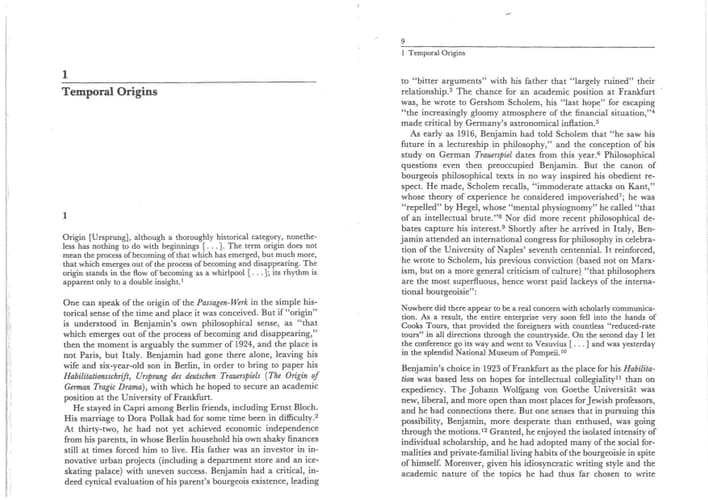
The Dialectics of Seeing: Walter Benjamin and the Arcades Project (Studies in Contemporary German Social Thought)
Susan Buck-MorssPublished1989
Pages505
Formathardcover
PublisherThe MIT Press
Synopsis
Walter Benjamin's magnum opus was a book he did not live to write. In The Dialectics of Seeing, Susan Buck-Morss offers an inventive reconstruction of the Passagen Werk, or Arcades Project, as it might have taken form.
Working with Benjamin's vast files of citations and commentary which contain a myriad of historical details from the dawn of consumer culture, Buck-Morss makes visible the conceptual structure that gives these fragments philosophical coherence. She uses images throughout the book to demonstrate that Benjamin took the debris of mass culture seriously as the source of philosophical truth.
The Paris Arcades that so fascinated Benjamin (as they did the Surrealists whose "materialist metaphysics" he admired) were the prototype, the 19th century "ur-form" of the modern shopping mall. Benjamin's dialectics of seeing demonstrate how to read these consumer dream houses and so many other material objects of the time - from air balloons to women's fashions, from Baudelaire's poetry to Grandville's cartoons - as anticipations of social utopia and, simultaneously, as clues for a radical political critique.
Buck-Morss plots Benjamin's intellectual orientation on axes running east and west, north and south - Moscow Paris, Berlin-Naples - and shows how such thinking in coordinates can explain his understanding of "dialectics at a standstill." She argues for the continuing relevance of Benjamin's insights but then allows a set of "afterimages" to have the last word.
Susan Buck-Morss is Professor of Political Philosophy and Social Theory at Cornell University. The Dialectics of Seeing is included in the series Studies in Contemporary German Social Thought, edited by Thomas McCarthy.
Recommendations
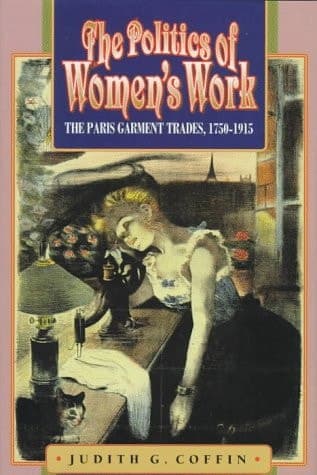
The Politics of Women's Work The Paris Garment Trades, 1750-1915
by Judith G. Coffin
Since you've just finished Buck-Morss's reconstruction of Benjamin's thinking, reading Aragon's *Paris Peasant* (the primary Surrealist text Benjamin himself was in dialogue with) will let you experience the raw material that inspired Benjamin's dialectical method. Aragon wanders the arcades with the same attention to debris and dream-logic that Benjamin theorized, giving you the phenomenological ground truth beneath the philosophical architecture you've just studied.
View book
Comments on the Society of the Spectacle
by Guy Debord
Debord takes Benjamin's insights about commodity culture and consumer consciousness and develops them into a full critique of late capitalism—he's essentially asking: what happens when the entire world becomes an arcade? His aphoristic style mirrors Benjamin's fragmentary approach, and his analysis of how images colonize reality feels like the natural endpoint of the trajectory Buck-Morss traces through Benjamin's work.
View book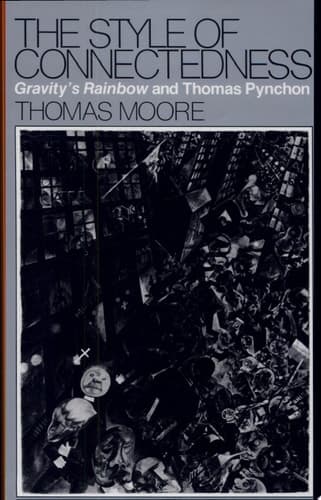
The Style of Connectedness Gravity's Rainbow and Thomas Pynchon
by Thomas Moore
I know this seems like a left turn, but Pynchon does something remarkably similar to what Benjamin attempted: he treats the detritus of 20th-century technology, consumer goods, and mass culture as vessels of hidden meaning and historical truth. The novel's paranoid attention to systems, its collage-like structure of fragments, and its refusal to separate 'high' theory from pulp entertainment all echo Benjamin's dialectical method—just expressed through narrative rather than philosophical reconstruction.
View book
The Practice of Everyday Life
by Michel de Certeau
De Certeau extends Benjamin's project into the realm of ordinary practice—he asks how people actually *use* the spaces and objects of consumer culture rather than simply being consumed by them. His concept of 'tactics' versus 'strategies' gives Benjamin's dialectics a more grounded, anthropological dimension, showing how the arcade's dream-logic plays out in the everyday tactics of shoppers, readers, and urban wanderers.
View book
The Savage Detectives A Novel
by Roberto Bolaño
Here's your surprise: Bolaño's sprawling novel operates like a literary Arcades Project for the late 20th century—it's a vast, fragmentary archive of conversations, footnotes, and marginal figures that treats bohemian culture and literary history as material for philosophical excavation. The novel's obsessive attention to obscure poets, failed movements, and the detritus of intellectual life mirrors Benjamin's method of finding utopian possibility in forgotten things, but filtered through a postmodern sensibility that questions whether such redemption is even possible.
View bookAbout Susan Buck-Morss
S
Susan Buck-Morss
Born 1942
Susan Buck-Morss (1942) is an American philosopher and intellectual historian. -Wikipedia
View author page