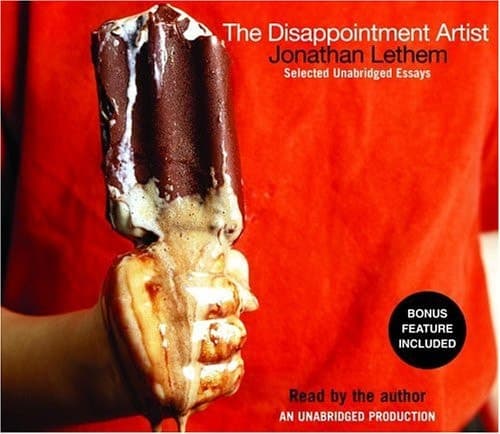
Synopsis
Review "Lethem is one of our most perceptive cultural critics, conversant in both the high and low realms, his insights buffeted by his descriptive imagination." —Los Angeles Times Book Review"He fearlessly analyzes his influences--movies, books, artists, friends, parents--and his insights are highly personal, but also often universal, and thus these essays reach the highest goal of the memoir form." —The Seattle Times"This is a gem of a book. . . . Heartbreaking. . . . Mesmerizing. . . . A form of smuggled autobiography. . . . With a few deft strokes, the reader is left with a vivid image of Lethem’s childhood." —The New York Observer"Moving. . . . Absolutely fascinating. . . . Dense with allusion and insight." —St. Louis Post-Dispatch“These marvelous explorations take us into the hiding places of the psyche, where second thoughts are assessed, secret-sharer sins confessed, and grief and loss redressed. In a collection as warmly engaging as it is ruminative, Jonathan Lethem shows himself to be as much a master of the personal essay as he is of contemporary fiction.”—Phillip LopateFrom the Trade Paperback edition. Product Description Lethem, Jonathan About the Author Jonathan Lethem is the author of six novels, including The Fortress of Solitude and Motherless Brooklyn, which won the National Book Critics Circle Award. He is also the author of two short story collections, Men and Cartoons and The Wall of the Sky, The Wall of the Eye, and the editor of The Vintage Book of Amnesia. His essays have appeared in The New Yorker, Rolling Stone, Granta,and Harper’s. He lives in Brooklyn and Maine.From the Trade Paperback edition. Excerpt. © Reprinted by permission. All rights reserved. Defending The Searchers(Scenes in the Life of an Obsession)1. BenningtonWhat's weird in retrospect is how I seem to have willed the circumstances into being, how much I seemed to know before I knew anything at all. There shouldn't have been anything at stake for me, seeing The Searchers that first time. Yet there was. Going to a film society screening was ordinarily a social act, but I made sure to go alone that night. I smoked a joint alone too, my usual preparation then for a Significant Moment. And I chose my heavy black-rimmed glasses, the ones I wore when I wanted to appear nerdishly remote and intense, as though to decorate my outer self with a confession of inner reality. The evening of that first viewing of The Searchers I readied myself like a man who suspects his first date might become an elopement.I wasn't a man. I was nineteen, a freshman at Bennington, a famously expensive college in Vermont. I'd never been to private school, and the distance between my experience and the other students', most of whom had never set foot inside a public school like those I'd attended in Brooklyn, would be hard to overstate. On the surface I probably came off like an exuberant chameleon. I plied my new friends with stories of inner-city danger when I wanted to play the exotic, aped their precocious cynicism when I didn't. Beneath that surface I was weathering a brutally sudden confrontation with the reality of class. My bohemian-artisan upbringing—my parents were hippies—had masked the facts of my own exclusion from real privilege, more adeptly than is possible anymore. It was 1982.Soon the weight of these confusions crushed my sense of belonging, and I dropped out. But before that, I cloaked my abreaction in a hectic show of confidence: I was the first freshman ever to run the film society. The role freed me to move easily through the complex social layers at Bennington, impressing people with a brightness that hadn't affixed to any real target. Plus I was able to hire myself as a projectionist, one of the least degrading work-study jobs, then pad the hours, since I was my own manager.So when I walked into Tishman Hall, Bennington's small, free-standing movie theater, I was entering my own little domain on a campus that re
Recommendations
Generating recommendations…
Our AI is preparing recommendations for The Disappointment Artist. This usually takes under a minute.
About Jonathan Lethem
J
Jonathan Lethem
Born 1964
Biography coming soon.
View author page