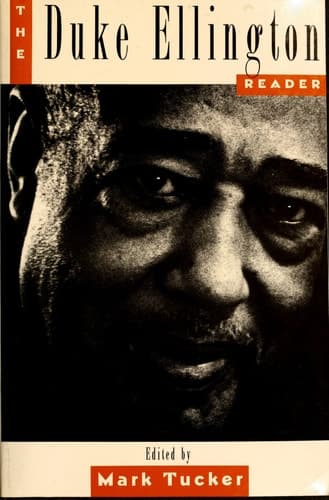
The Duke Ellington Reader
Duke EllingtonPublished1993
Pages536
Formatpaperback
PublisherOxford University Press
Synopsis
Duke Ellington is universally recognized as one of the towering figures of 20th-century music, both a brilliant composer and one of the preeminent musicians in jazz history. From early pieces such as East St. Louis Toodle-O, Black and Tan Fantasy, It Don't Mean a Thing, and Mood Indigo, to his more complex works such as Reminiscing in Tempo and Black, Brown and Beige, to his later suites and sacred concerts, he left an indelible mark on the musical world. Now, in The Duke Ellington Reader, Mark Tucker offers the first historical anthology of writings about this major African-American musician. The volume includes over a hundred selections--interviews, critical essays, reviews, memoirs, and over a dozen writings by Ellington himself--with generous introductions and annotations for each selection provided by the editor. The result is a unique sourcebook that illuminates Ellington's work and reveals the profound impact his music has made on listeners over the years.
The writers gathered here represent a Who's Who of jazz criticism: Gunther Schuller, Whitney Balliett, Martin Williams, Gary Giddins, Stanley Crouch, Albert Murray, Nat Hentoff, Hugues Panassie, Stanley Dance, to name just a few. Their writings span Ellington's entire career, from the days when Duke Ellington's Washingtonians appeared at New York's Club Kentucky ("Probably the 'hottest' band this side of the equator"), to the Duke's glorious reign at the Cotton Club, to his later years as global ambassador of American music. Tucker has included some of the classic essays written about Ellington, such as R. D. Darrell's "Black Beauty," the first significant critical essay on Ellington's work and still one of the most important; Richard O. Boyer's lengthy New Yorker profile "The Hot Bach," printed here in its entirety; and Martin Williams's "Form Beyond Form," one of the best capsule introductions to Ellington's art. Throughout the book, the reader receives a balanced overview of Ellington's life as composer and performer, as public personality and private individual. Tucker provides a number of pieces on Ellington's compositions, including an entire chapter devoted to critical response to Ellington's Black, Brown and Beige, and there are also many moving pieces on Ellington the man, such as Ralph Ellison's tribute to Ellington on his 70th birthday, and Stanley Dance's funeral address. Finally, Tucker rounds out the collection with profiles on many of the outstanding musicians who worked with Ellington, among them Johnny Hodges, Bubber Miley, Billy Strayhorn, Ivie Anderson, Sonny Greer, Joe "Tricky Sam" Nanton, and Ben Webster.
This is a landmark volume in jazz criticism, a kaleidoscopic portrait of Duke Ellington's creative world, documenting his extraordinary achievements as composer, songwriter, bandleader, and pianist. It is an essential companion for Ellington enthusiasts, jazz fans, and serious students of American music.
Recommendations
Straight Life The Story Of Art Pepper
by Art Pepper
Like the Ellington Reader, this is a musician's own voice woven through critical and personal perspectives, but Pepper's autobiography has an rawer, more confessional quality—you get the unvarnished truth about addiction, racism, and artistic struggle alongside the music criticism. It's the same archival approach to understanding a jazz giant, but filtered through one man's brutal honesty rather than a curated anthology.
View book
Alex Haley's The Autobiography of Malcolm X
by Anita J. Aboulafia
This shares the Reader's interest in African-American cultural history and intellectual development, but approaches it through a political and spiritual lens rather than purely musical. You'll find the same meticulous attention to how a brilliant mind navigates American society, and the same sense of a life that becomes inseparable from historical moment.
View book
The Letters of Vincent Van Gogh
by Vincent Van Gogh
Here's the curveball: instead of jazz criticism, you get an artist's unfiltered correspondence about his own creative process, struggles, and vision. Like the Ellington Reader's inclusion of Ellington's own writings, van Gogh's letters reveal how a towering figure understood their own work—but they're more intimate and desperate, giving you access to the mind of genius in real time rather than in retrospect.
View book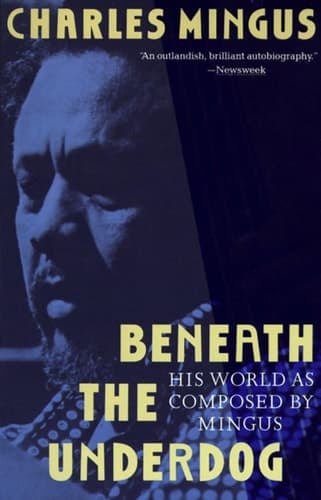
Beneath the Underdog: His World as Composed by Mingus
by Charles Mingus
Mingus was Ellington's contemporary and spiritual heir, and this memoir reads like a fever dream compared to the scholarly distance of the Reader—it's fragmented, angry, and gorgeously written, capturing both the music and the man's volcanic personality. You'll recognize the same era of jazz history and the same questions about artistic freedom, but told from inside the storm rather than from the archive.
View book
Ralph Ellison - Invisible Man
by Anke Balduf
You've already encountered Ellison's voice in the Ellington Reader—his tribute to Duke is luminous—and this novel is where that same sensibility lives: a meditation on identity, invisibility, and what it means to be a Black artist in America, threaded through with jazz rhythms and musical references. It's literary fiction, yes, but it's the novel that best captures the cultural world that produced and celebrated Ellington.
View bookAbout Duke Ellington
Biography coming soon.
View author page