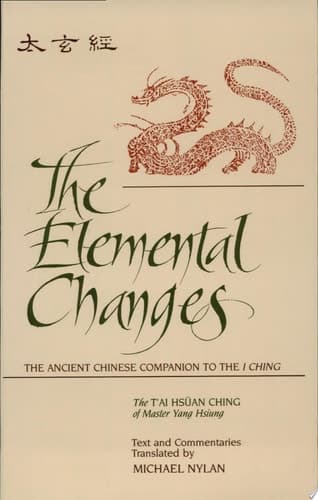
The Elemental Changes The Ancient Chinese Companion to the I Ching. The T'ai Hsüan Ching of Master Yang Hsiung Text and Commentaries translated by Michael Nylan
Hsiung YangPublished1994
Pages391
Formatpaperback
PublisherSUNY Press
Synopsis
Composed in 2 B.C., as "The I Ching revised and enlarged," The Elemental Changes is a divination manual providing a clear method for distinguishing alternative courses of action. Structured in 81 tetragrams ( as opposed to the 64 hexagrams of the I Ching), the book offers much to the modern reader. Today in the West, The Elemental Changes is an essential tool for understanding the Tao as it operates in the Cosmos, in the minds of sages, and in sacred texts. It is also one of the great philosophical poems in world literature, assessing the rival claims on human attention of fame, physical immortality, wealth, and power while it situates human endeavor within the larger framework of cosmic energies.
The complete text of The Elemental Changes and its ten autocommentaries are here translated into accessible and, whenever possible, literal English. Following the Chinese tradition, supplementary comments are appended to each tetragram in order to indicate the main lines of interpretation suggested by earlier commentators.
Recommendations
The Secret of the Golden Flower The Classic Chinese Book of Life
by Dongbin Lü
Like the T'ai Hsüan Ching, this is a classical Chinese esoteric text that uses poetic, paradoxical language to describe internal transformation and the circulation of cosmic energy through the body. Cleary's translation maintains the same scholarly rigor and accessibility that Nylan brings to the Elemental Changes, making ancient wisdom feel immediately relevant to contemporary spiritual practice.
View book
The Savage Detectives A Novel
by Roberto Bolaño
This might seem like a departure, but hear me out: both works are fundamentally about following multiple threads of meaning simultaneously and trusting the reader to find coherence in apparent fragmentation. Where the Elemental Changes uses 81 tetragrams as entry points into cosmic truth, Bolaño uses interlocking narratives and footnotes to suggest that meaning emerges from the spaces between texts rather than within them. It's philosophical fiction that rewards the same kind of meditative, non-linear reading.
View book
The Tao of Physics
by Fritjof Capra
Published in 1975, this bridges the exact gap you've been exploring—how ancient Chinese cosmological thinking (including I Ching principles) actually maps onto modern quantum mechanics and systems theory. Capra writes with genuine intellectual humility, showing how Yang Hsiung's framework for understanding dynamic balance isn't mystical decoration but a sophisticated model of how reality actually works.
View book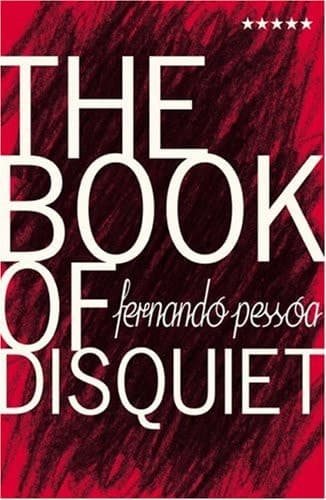
The Book of Disquiet
by Fernando Pessoa
Pessoa's fragmented philosophical diary shares the Elemental Changes' obsession with how consciousness navigates competing truths—fame versus obscurity, action versus contemplation, the self versus the cosmos. Both texts refuse to resolve these tensions into neat answers; instead, they offer aphorisms and meditations that sit alongside each other, allowing contradictions to coexist. It's philosophy written as poetry written as lived experience.
View book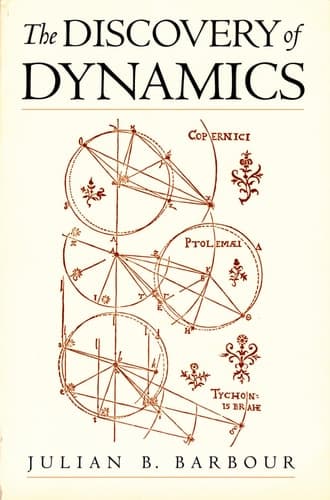
The Discovery of Dynamics A Study from a Machian Point of View of the Discovery and the Structure of Dynamical Theories
by Julian B. Barbour
A genuine surprise: this philosophy of science text uses structural analysis to show how different frameworks for understanding reality (scientific, religious, poetic) aren't competing but rather different ways of organizing the same underlying patterns. Van Fraassen's thinking echoes the Elemental Changes' core insight—that the Tao operates through structure and relationship, not fixed essences—but applies it to how we actually construct knowledge in the modern world.
View bookAbout Hsiung Yang
Biography coming soon.
View author page