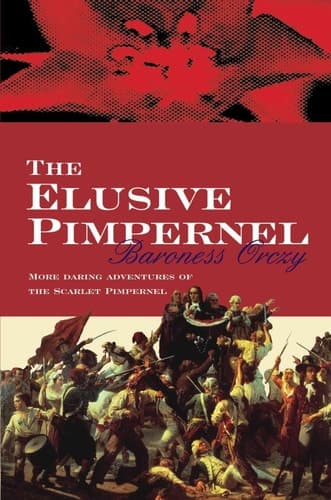
Synopsis
From the book:There was not even a reaction. On! ever on! in that wild, surging torrent; sowing the wind of anarchy, of terrorism, of lust of blood and hate, and reaping a hurricane of destruction and of horror. On! ever on! France, with Paris and all her children still rushes blindly, madly on; defies the powerful coalition, - Austria, England, Spain, Prussia, all joined together to stem the flow of carnage, - defies the Universe and defies God! Paris this September 1793! - or shall we call it Vendemiaire, Year I. of the Republic? - call it what we will! Paris! a city of bloodshed, of humanity in its lowest, most degraded aspect. France herself a gigantic self-devouring monster, her fairest cities destroyed, Lyons razed to the ground, Toulon, Marseilles, masses of blackened ruins, her bravest sons turned to lustful brutes or to abject cowards seeking safety at the cost of any humiliation.
Recommendations
Generating recommendations…
Our AI is preparing recommendations for The Elusive Pimpernel. This usually takes under a minute.
About Baroness Emmuska Orczy Orczy
B
Baroness Emmuska Orczy Orczy
1865–1947
Baroness Emma Magdolna Rozália Mária Jozefa Borbála "Emmuska" Orczy de Orczi was born in Tarnaörs, Heves County, Hungary, the daughter of composer Baron Felix Orczy and Countess Emma Wass. In 1868, fearing a potential peasant revolution, her parents left Hungary. They lived in Budapest, Brussels, and Paris before settling in London in 1880. Orczy attended West London School of Art and then Heatherley's School of Fine Art. In 1894, she married illustrator Montague MacLean Barstow, whom she had met at art school. The couple had very little money, and Orczy started to work with her husband as a translator and an illustrator. In 1899, she had a child, and published her first novel, The Emperor's Candlesticks. In 1903, she and her husband coauthored her most famous work, The Scarlet Pimpernel. She went on to write over a dozen sequels to the novel. She also created a number of memorable detectives: Lady Molly Robertson-Kirk of Scotland Yard, who heads the "Female Department" (her cases are collected in *Lady Molly of Scotland Yard*, 1910); Monsieur Fernand, a Napoleonic-era secret agent (*The Man in Grey*, 1918); and Patrick Mulligan, a shady attorney (*Skin o' My Tooth*, 1928). Her greatest detective was the Old Man in the Corner, probably the first of the "armchair" detectives. He sits in a chair in a London tea shop, unraveling knots and intricate cases brought to him by Polly Burton, a young reporter. Many of these were later collected in *The Old Man in the Corner* (1909). [Leslie S. Klinger, *In the Shadow of Sherlock Holmes* (2011)]
View author page