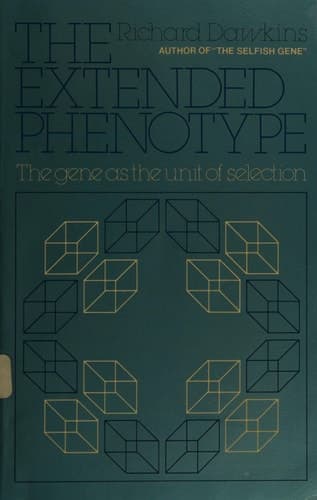
The Extended Phenotype The Gene as the Unit of Selection
Richard DawkinsPublished1983
Pages307
Formatpaperback
PublisherOxford University Press
Synopsis
People commonly view evolution as a process of competition between individuals--known as "survival of the fittest"--with the individual representing the "unit of selection." Richard Dawkins offers a controversial reinterpretation of that idea in The Extended Phenotype, now being reissued to coincide with the publication of the second edition of his highly-acclaimed The Selfish Gene. He proposes that we look at evolution as a battle between genes instead of between whole organisms. We can then view changes in phenotypes--the end products of genes, like eye color or leaf shape, which are usually considered to increase the fitness of an individual--as serving the evolutionary interests of genes.
Dawkins makes a convincing case that considering one's body, personality, and environment as a field of combat in a kind of "arms race" between genes fighting to express themselves on a strand of DNA can clarify and extend the idea of survival of the fittest. This influential and controversial book illuminates the complex world of genetics in an engaging, lively manner.
Recommendations
Generating recommendations…
Our AI is preparing recommendations for The Extended Phenotype The Gene as the Unit of Selection. This usually takes under a minute.
About Richard Dawkins
R
Richard Dawkins
Born 1941
Clinton Richard Dawkins, FRS, FRSL is a British ethologist, evolutionary biologist and popular science author. He was formerly Professor for Public Understanding of Science at Oxford and was a fellow of New College, Oxford. Dawkins came to prominence with his 1976 book *The Selfish Gene*, which popularised the gene-centred view of evolution and introduced the term meme. In 1982, he made a widely cited contribution to evolutionary biology with the concept, presented in his book *The Extended Phenotype*, that the phenotypic effects of a gene are not necessarily limited to an organism's body, but can stretch far into the environment, including the bodies of other organisms. Dawkins is well known for his candid criticism of creationism and intelligent design. In his 1986 book *The Blind Watchmaker*, he argued against the watchmaker analogy, an argument for the existence of a supernatural creator based upon the complexity of living organisms. Instead, he described evolutionary processes as analogous to a blind watchmaker. He has since written several popular science books, and makes regular television and radio appearances, predominantly discussing these topics. ([Source][1]) [1]: http://en.wikipedia.org/wiki/Richard_Dawkins
View author page