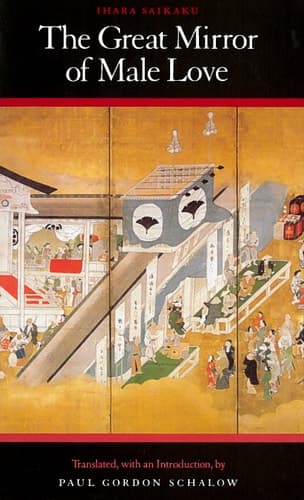
The Great Mirror of Male Love
Ihara SaikakuPublished1990
Pages371
Formathardcover
PublisherStanford University Press
Synopsis
The first complete translation of Nanshoku okagami by Ihara Saikaku (1642-93), this is a collection of 40 stories describing homosexual love affairs between samurai men and boys and between young kabuki actors and their middle-class patrons. Seventeenth-century Kyoto was the center of a flourishing publishing industry, and for the first time in Japan's history it became possible for writers to live exclusively on their earnings. Saikaku was the first to actually do so. As a popular writer, Saikaku wanted to entertain his readership. When he undertook the writing of Nanshoku okagami in 1687, it was with the express purpose of extending his readership and satisfying his ambition to be published in the three major cities of his day, Kyoto, Osaka, and Edo. He chose the topic of male homosexual love because it had the broadest appeal both to the samurai men of Edo and to the townsmen of Kyoto and Osaka, his regular audience. Homosexual relations between a man and a boy were a regular feature of premodern Japanese culture and carried no stigma. When a boy reached the age of nineteen, he underwent a coming-of-age ceremony, after which he took the adult role in relations with boys."
Recommendations

Murasaki Shikibu The Tale of Genji
by Richard Bowring
Like Saikaku, Murasaki was writing about the aristocratic world she knew intimately, but she's doing it centuries earlier and with psychological depth that feels almost modern. Both authors capture desire and relationship dynamics across different social hierarchies in Heian/Edo Japan, but where Saikaku entertains with variety, Murasaki traces the emotional consequences of attraction with remarkable subtlety.
View book
Giovanni's Room
by James Baldwin
Baldwin's novella shares Saikaku's unflinching examination of male same-sex desire, but transplants it to 1950s Paris and America where such love carries tremendous social weight and shame. Reading them together creates an illuminating contrast—Saikaku's matter-of-fact storytelling about normalized desire versus Baldwin's exploration of desire in a culture that criminalizes it. Both are ultimately about how people navigate love within their specific historical moment.
View book
The Pillow Book of Sei Shonagon
by Sei Shonagon
This is my surprise pick for you—it's not narrative fiction like Saikaku, but rather fragmented observations and lists from a Heian court lady. Yet it shares that same Japanese sensibility of finding profound meaning in aesthetic moments and social interactions. Where Saikaku gives you 40 complete stories, Shonagon gives you thousands of compressed observations about beauty, desire, and human nature. It's a completely different form, but the cultural DNA is unmistakable.
View book
Tales from the Decameron of Giovanni Boccaccio
by Giovanni Boccaccio
Boccaccio's 14th-century frame narrative of 100 stories shares Saikaku's structural DNA—a collection designed to entertain a broad audience with tales of desire, intrigue, and human folly. Both authors are writing for newly literate middle-class readers and using variety as their strategy. The stories span from bawdy comedy to tragic romance, and like Saikaku, Boccaccio treats sexuality matter-of-factly as simply part of how people behave.
View book
Confessions of a Mask
by Yukio Mishima
Mishima's semi-autobiographical novel is set in 20th-century Japan and traces a young man's discovery of his own desire while navigating rigid social expectations—a direct literary descendant of the world Saikaku documented. But where Saikaku's characters move through their desires with relative ease, Mishima's narrator is tormented by the gap between his inner life and his public performance. It's a meditation on what happens when that cultural permission Saikaku describes has been withdrawn.
View bookAbout Ihara Saikaku
Biography coming soon.
View author page