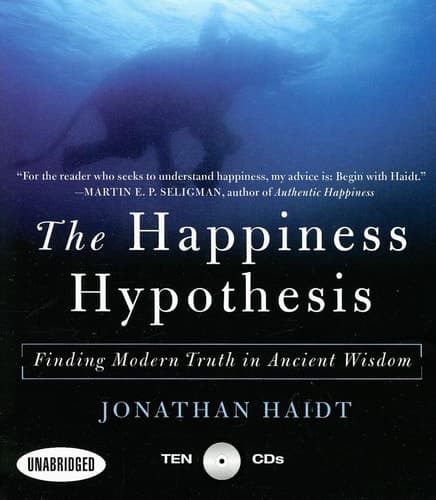
The Happiness Hypothesis: Finding Modern Truth in Ancient Wisdom...Why the Meaningful Life is Closer Than You Think
Jonathan HaidtPublished2011
Formataudiobook
PublisherGildan Media
Synopsis
This is a book about 10 "Great Ideas". Each chapter is an attempt to savor one idea that has been discovered by several of the world's civilizations - to question it in light of what we now know from scientific research, and to extract from it the lessons that still apply to our modern lives.
Recommendations

Thinking Past Terror Islamism and Critical Theory on the Left
by Susan Buck-Morss
Kahneman does what Haidt does but zooms in on a single domain—how our minds actually work beneath conscious awareness. Where Haidt synthesizes wisdom across cultures, Kahneman dissects the machinery of decision-making itself, and you'll find yourself constantly recognizing the cognitive biases he describes in your own daily choices. Both authors write with the same patient, almost conversational tone that makes complex psychology feel like a conversation with a wise friend.
View book
The Struggle for Life A Companion to William James's The Varieties of Religious Experience
by Donald Capps
Published in 1902, this is the grandfather of Haidt's project—James was doing exactly what Haidt does now, but examining religious and spiritual experiences across cultures with genuine curiosity rather than dismissal. Reading it after Haidt creates a fascinating dialogue across time; you'll see how James's observations about meaning-making still hold up, and where modern neuroscience has refined or challenged his conclusions. It's a surprise recommendation because it reads more like intimate case studies than a typical philosophy text.
View book
The God Code The Secret of Our Past, the Promise of Our Future
by Gregg Braden
Henrich takes Haidt's interest in why different cultures developed different wisdom and asks a harder question: *how* did humans become so dependent on cultural knowledge in the first place? He traces the evolutionary logic behind our need for accumulated wisdom, which gives you a deeper foundation for understanding why those ten great ideas Haidt explores actually stuck around. It's denser than Haidt but rewards careful reading with genuine insight into human nature.
View book
Friendship Bands Braiding, Weaving, Knotting
by Marlies Busch
This is the surprise pick—it's part essay, part nature writing, part Indigenous philosophy, and it approaches ancient wisdom through direct observation and relationship rather than academic analysis. Where Haidt examines ideas about gratitude and virtue, Kimmerer *embodies* them through her descriptions of plants and reciprocity, showing you how wisdom lives in practice, not just in theory. It's a completely different genre from Haidt, but it answers the same hunger: how do we live better by learning from what humans have always known?
View book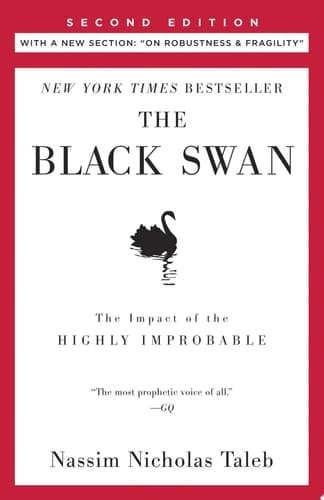
The Black Swan: Second Edition The Impact of the Highly Improbable: With a new section: "On Robustness and Fragility"
by Nassim Nicholas Taleb
Taleb takes Haidt's interest in timeless ideas and asks which ones actually *work* under stress and uncertainty—he's essentially testing ancient wisdom against real-world volatility. His writing is more combative and idiosyncratic than Haidt's measured tone, but he's after the same thing: extracting practical truth from philosophy, history, and science. If you found yourself wanting Haidt to push harder on which ideas actually matter most, Taleb will scratch that itch.
View bookAbout Jonathan Haidt
J
Jonathan Haidt
Born 1963
Jonathan David Haidt (/haɪt/; born October 19, 1963) is an American social psychologist, Professor of Ethical Leadership at New York University Stern School of Business,[1] and author. His main areas of study are the psychology of morality and moral emotions. Haidt's main scientific contributions come from the psychological field of moral foundations theory,[2] which attempts to explain the evolutionary origins of human moral reasoning on the basis of innate, gut feelings rather than logical reason.[3] The theory was later extended to explain the different moral reasoning and how they relate to political ideology, with different political orientations prioritizing different sets of morals.[4] The research served as a foundation for future books on various topics. Haidt has written three books for general audiences, including: The Happiness Hypothesis: Finding Modern Truth in Ancient Wisdom (2006) explores the relationship between ancient philosophies and modern science;[5] The Righteous Mind: Why Good People are Divided by Politics and Religion (2012) examines how morality is shaped by emotion and intuition more than by reasoning, and why differing political groups have different notions of right and wrong;[6] and The Coddling of the American Mind: How Good Intentions and Bad Ideas Are Setting Up a Generation for Failure (2018), co-written with Greg Lukianoff, explores the rising political polarization and changing culture on college campuses, and its effects on mental health. Haidt has attracted both support and criticism for his critique of the current state of universities and his interpretation of progressive values.[7] He has been named one of the "top global thinkers" by Foreign Policy magazine, and one of the "top world thinkers" by Prospect magazine.[8][9] He is among the most cited researchers in political and moral psychology, and is considered among the top 25 most influential living psychologists
View author page