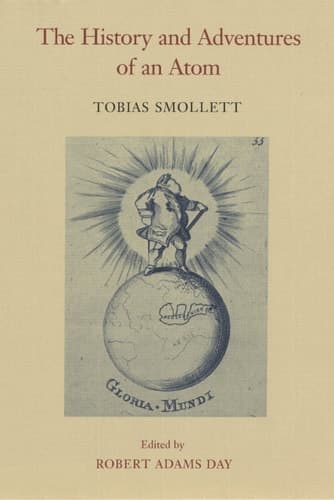
The History and Adventures of an Atom
Tobias SmollettPublished1989
Pages360
Formathardcover
PublisherUniversity of Georgia Press
Synopsis
In The History and Adventures of an Atom, a London haberdasher relates extraordinary tales of ancient Japan as dictated to him by an omniscient atom that has lived within the bodies of great figures of state. Intended “for the instruction of British ministers,” the work is a savage allegory of England during the Seven Years’ War (1756-1763), draping kings and politicians, domestic and foreign affairs in an intricately detailed, endlessly allusive veil of satire. Lacing his commentary with vitriol, Tobias Smollett gives fantastic expression in the Atom to many of the concerns voiced in his historical and political writings. He creates from the details of Japanese history an ingenious catalog of English places and personalities--from the up-start ruler “Taycho,” whose graspings for power resemble William Pitt’s, to a god of war called “Fatzman” who suggests the grotesquely obese Duke of Cumberland. Smollett also draws on the imagery of the period’s scurrilous political cartoons and injects into his satire a Rabelaisian humor that makes this work perhaps the most scatological in English literature.
Edited and introduced by Robert Adams Day, this edition of the Atom is the first to appear since 1926 and the first ever to provide a carefully prepared text, a full apparatus of historical annotations, and an accurate key to personages and places. Day establishes the authorship and the long-disputed work, placing it within the context of Smollett’s writings and opinions, his times and literary world.
Recommendations
Gulliver's Travels, Jonathan Swift
by Mary Sewell
Swift's savage political allegory wrapped in fantastical travel narratives shares Smollett's gift for weaponizing absurdity against his contemporaries. Both authors use impossible scenarios—an atom inhabiting statesmen, a man visiting tiny kingdoms—as vehicles for anatomizing the stupidity and venality of their own governments, and both do it with a scatological relish that makes their satire genuinely visceral rather than merely clever.
View book
The Apocalyptic Vision of Mikhail Bulgakov's the Master and Margarita (Studies in Slavic Language & Literature)
by Edward E. Ericson
Here's your surprise pick: Bulgakov's Soviet-era novel operates on the same principle as Smollett's Atom—layering contemporary political critique beneath a fantastical narrative that seems to be about something entirely different (in this case, the Devil visiting Moscow). The intricacy of the historical annotation you appreciated in the Smollett edition becomes essential here too; Bulgakov is encoding his critique so densely that readers need the same kind of scholarly apparatus to catch all the targets.
View book
Laurence Sterne, "Tristram Shandy"
by Anne Dromart
Sterne's digressive masterpiece shares Smollett's anarchic energy and his willingness to let formal structure collapse in service of satire and humor. Where Smollett uses an atom's perspective to defamiliarize politics, Sterne uses typographical tricks and narrative chaos to defamiliarize storytelling itself—both are 18th-century writers who treat the novel form as something to be gleefully dismantled rather than respected.
View book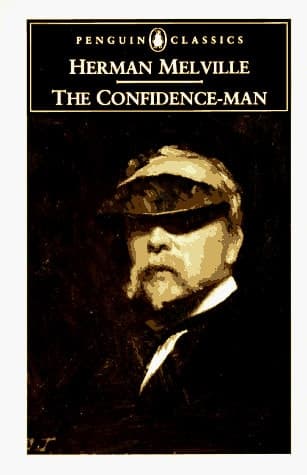
The Confidence-Man His Masquerade
by Herman Melville
Melville's American riverboat novel captures that same Smollett quality of using a picaresque structure to expose systematic hypocrisy and corruption—here, every passenger is either a con artist or a mark, and the book refuses to let you settle into comfortable judgments about who's who. Like the Atom, it's a work that rewards close reading and historical knowledge, and it has that same darkly comic tone about human nature and institutions.
View bookAbout Tobias Smollett
Biography coming soon.
View author page