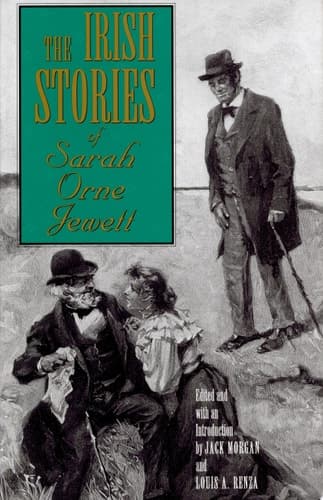
The Irish Stories of Sarah Orne Jewett
Sarah Orne JewettPublished1996
Pages149
Formathardcover
PublisherSIU Press
Synopsis
Originally published in Scribner's, The Cosmopolitan, McClure's, and Lippincott's, Sarah Orne Jewett's stories about Irish immigrant figures constitute a neglected corner of her oeuvre, despite the fact that Jewett herself entertained the possibility of collecting them into a volume to be called Transplanted Shamrocks. Because the proposed collection never appeared, Jewett's tales of the Irish in America, stories that constitute an invaluable historical and literary record, appear together for the first time in this anthology. These eight stories represent the first serious treatment of the Irish in America by an important literary figure.
After a visit to Ireland in 1882, this superior nineteenth-century New England writer expanded the scope of her interests to provide fictional portraits of the newly arrived Irish population. She told the sometimes happy and more often sad tales of their acculturation in "The Luck of the Bogans" (1889), "A Little Captive Maid" (1891), "Between Mass and Vespers" (1893), "The Gray Mills of Farley" (1898), "Where's Nora?" (1898), "Bold Words at the Bridge" (1899), "A Landlocked Sailor" (1899), and" Elleneen" (1901). For Jewett, the Irish comprised a unique and fascinating addition to the New England local color figures it was her life's work to represent in literary fiction. She believed the Irish immigrant brought a new vitality and charm to the New England landscape.
In their introduction, editors Jack Morgan and Louis A. Renza point out that in these stories Jewett displayed a remarkable empathy for the Irish. Undoing the "Paddy" stereotype favored in nineteenth-century Yankee discourse, Jewett exhibited an understanding of the immigrant psyche unheard of among her fellow writers-- including Emerson and Thoreau, both of whom wrote disdainfully of the Irish.
Morgan and Renza further discuss the stories in the context of contemporary multicultural and ethnic concerns, showing that Jewett's Irish stories demonstrate a renewal--a redefining, questioning, and expanding of cultural boundaries within concentrated American communities, her own New England area in particular. As such, the editors contend, the stories constitute important documents in the history of a country still engaged with the multiethnic as well as the multi-individualist paradox of "E pluribus unum."
Above all, however, these stories are touching and deeply felt treatments of subjects dear to her heart by one of our major writers.
Recommendations
Henry James Daisy Miller * Washington Square * the Portrait of a Lady * the Bostonians * the Aspern Papers
by Henry James
James captures the same New England social landscape as Jewett, but through the lens of competing ideologies and class tensions that swirl around his characters—particularly the immigrant and working-class figures who exist at the margins of Boston society. Where Jewett offers empathy and intimate portraiture, James gives you the psychological complexity of how outsiders navigate a rigid social hierarchy, and his dialogue crackles with the unspoken resentments that simmer beneath polite conversation.
View book
Anne Brontë, The Tenant of Wildfell Hall Notes
by Hana Sambrook
Brontë writes about a woman who's been transplanted—socially and geographically—and must navigate a community's judgment and curiosity about her past, much like Jewett's Irish characters navigating New England suspicion. The novel has that same quiet intensity about how people survive in places where they don't quite belong, and Brontë's unflinching look at female independence and economic vulnerability gives you a different angle on the immigrant psyche Jewett explores.
View book
The Fortunate Pilgrim
by Mario Puzo
This is the surprise pick—Puzo's novel about an Italian immigrant mother in early 20th-century New York does for Italian Americans what Jewett attempted for the Irish: it strips away stereotype and reveals the fierce dignity, pragmatism, and heartbreak of transplantation. Published decades after Jewett, it shows how later writers built on that same empathetic framework she pioneered, and Puzo's unflinching portrayal of poverty and survival has the same emotional weight as Jewett's 'sometimes happy and more often sad tales.'
View book
The remains of the day de Kazuo Ishiguro
by Gallix/François
You might not expect this recommendation, but Ishiguro shares Jewett's gift for revealing character through restraint—his butler Stevens is as much an outsider in his own world as Jewett's Irish servants are in theirs, and both writers use quiet observation to expose the emotional costs of displacement and cultural dislocation. The novel's exploration of how people internalize the values of communities that don't quite accept them echoes the psychological depth Jewett brings to her immigrant portraits.
View bookAbout Sarah Orne Jewett
Biography coming soon.
View author page