Synopsis
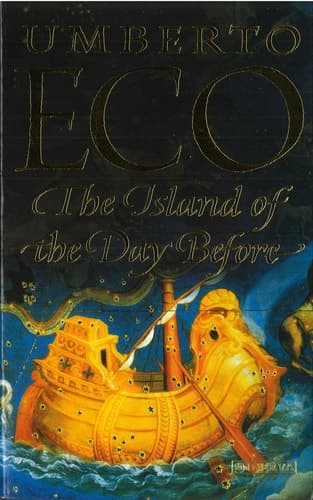
After a violent storm in the South Pacific (the year is 1643), Roberto della Griva finds himself shipwrecked - on a ship. Swept from the Amaryllis, he has managed to pull himself aboard the Daphne, anchored in the bay of a beautiful island. The ship is fully provisioned, he discovers, but the crew is missing. In this fascinating, lyrical tale, Umberto Eco tells of an international race to establish the Punto Fijo of a young dreamer searching for love and meaning; and of a most amazing old Jesuit who, with his clocks and maps, has plumbed the secrets of longitudes, the four moons of Jupiter, and the Flood.
Recommendations
Generating recommendations…
Our AI is preparing recommendations for The Island of the Day Before. This usually takes under a minute.
About Umberto Eco
U
Umberto Eco
1932–2016
Umberto Eco (5 January 1932 – 19 February 2016) was an Italian novelist, literary critic, philosopher, semiotician, and university professor. He is widely known for his 1980 novel Il nome della rosa (The Name of the Rose), a historical mystery combining semiotics in fiction with biblical analysis, medieval studies, and literary theory. He later wrote other novels, including Il pendolo di Foucault (Foucault's Pendulum) and L'isola del giorno prima (The Island of the Day Before). His novel Il cimitero di Praga (The Prague Cemetery), released in 2010, topped the bestseller charts in Italy. Eco also wrote academic texts, children's books, and essays, and edited and translated into Italian books from French, such as Raymond Queneau’s “Exercises in Style” (1983). He was the founder of the Department of Media Studies at the University of the Republic of San Marino,[3] president of the Graduate School for the Study of the Humanities at the University of Bologna, member of the Accademia dei Lincei, and an honorary fellow of Kellogg College, Oxford.
View author page