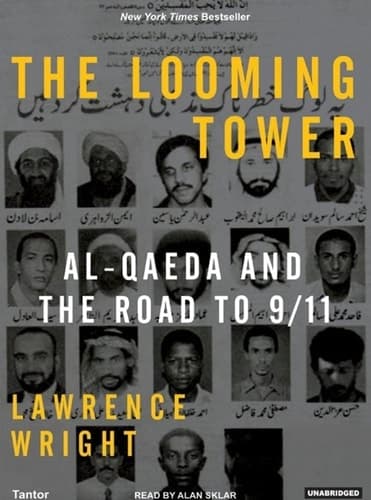
The Looming Tower: Al-Qaeda and the Road to 9/11
Lawrence WrightPublished2006
Pages14
Formataudiobook
PublisherTantor Audio
Synopsis
A sweeping narrative history of the events leading to 9/11, a groundbreaking look at the people and ideas, the terrorist plans and the Western intelligence failures that culminated in the assault on America. Lawrence Wright's remarkable book is based on five years of research and hundreds of interviews that he conducted in Egypt, Saudi Arabia, Pakistan, Afghanistan, Sudan, England, France, Germany, Spain, and the United States. The Looming Tower achieves an unprecedented level of intimacy and insight by telling the story through the interweaving lives of four men: the two leaders of al-Qaeda, Osama bin Laden and Ayman al-Zawahiri; the FBI's counterterrorism chief, John O'Neill; and the former head of Saudi intelligence, Prince Turki al-Faisal. As these lives unfold, we see revealed: the crosscurrents of modern Islam that helped to radicalize Zawahiri and bin Laden . . . the birth of al-Qaeda and its unsteady development into an organization capable of the American embassy bombings in Kenya and Tanzania and the attack on the USS Cole . . . O'Neill's heroic efforts to track al-Qaeda before 9/11, and his tragic death in the World Trade towers . . . Prince Turki's transformation from bin Laden's ally to his enemy . . . the failures of the FBI, CIA, and NSA to share intelligence that might have prevented the 9/11 attacks. The Looming Tower broadens and deepens our knowledge of these signal events by taking us behind the scenes. Here is Sayyid Qutb, founder of the modern Islamist movement, lonely and despairing as he meets Western culture up close in 1940s America; the privileged childhoods of bin Laden and Zawahiri; family life in the al-Qaeda compounds of Sudan and Afghanistan; O'Neill's high-wire act in balancing his all-consuming career with his equally entangling personal life-he was living with three women, each of them unaware of the others' existence-and the nitty-gritty of turf battles among U.S. intelligence agencies. Brilliantly conceived and written, The Looming Tower draws all elements of the story into a galvanizing narrative that adds immeasurably to our understanding of how we arrived at September 11, 2001. The richness of its new information, and the depth of its perceptions, can help us deal more wisely and effectively with the continuing terrorist threat.
Recommendations
Ghost Wars The Secret History of the CIA, Afghanistan, and bin Laden, from the Soviet Invasion to September 10, 2001 (Pulitzer Prize Winner)
by Steve Coll
Coll takes the same historical moment Wright covers but zooms in on the CIA's parallel investigation and the geopolitical chess game in Afghanistan—you'll find the same meticulous reporting and interconnected character studies, but with a different institutional perspective that fills gaps The Looming Tower leaves deliberately open. Where Wright focuses on personalities, Coll emphasizes how bureaucratic dysfunction and Cold War legacies shaped the intelligence failures.
View book
The Apocalyptic Vision of Mikhail Bulgakov's the Master and Margarita (Studies in Slavic Language & Literature)
by Edward E. Ericson
This might seem like a left turn, but hear me out: just as Wright weaves together disparate lives and ideologies to show how history actually unfolds, Bulgakov uses magical realism to explore how totalitarian systems corrupt individuals and institutions from within. Both books are ultimately about how power operates through people, and both demand you hold multiple contradictory truths simultaneously—the surreal sections of Bulgakov mirror the almost-unbelievable real events Wright documents.
View book
How to Keep a Man in Love with You Forever
by Tracy Cabot
I know this sounds counterintuitive—it's intimate domestic fiction rather than geopolitics—but Knausgård shares Wright's obsessive attention to the granular details of how people actually live and think. Just as Wright reconstructs bin Laden's childhood and O'Neill's secret relationships to explain radicalization and obsession, Knausgård excavates the mundane moments that reveal character. Both writers trust that understanding the texture of a life—what someone ate, who they loved, what they feared—is essential to understanding history.
View book
Utopia Guide to Indonesia (2nd Edition) The Gay and Lesbian Scene in 43 Cities Including Jakarta and the Island of Bali
by John Goss
Where Wright examines how extremism develops in response to geopolitical conditions, Prashad documents the Western interventions that created those conditions in the first place—this is the counternarrative that contextualizes everything in The Looming Tower. He uses the same archival rigor and interview-based reporting Wright does, but his scope is broader, showing patterns across decades and continents that explain why certain regions became radicalization hotbeds.
View bookAbout Lawrence Wright
L
Lawrence Wright
Born 1947
Biography coming soon.
View author page