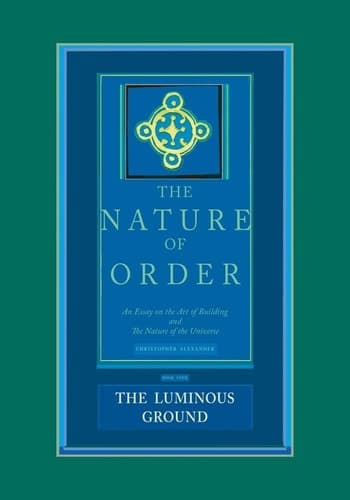
The Luminous Ground An Essay on the Art of Building and the Nature of the Universe
Christopher AlexanderPublished2004
Pages356
Formathardcover
PublisherCenter for Environmental Structure
Synopsis
The foundations of modern scientific thought, four centuries old, are firmly rooted in a conception that the universe is a machinelike entity, a play of baubles, -machines, trinkets. Quantum mechanics and biology have begun to change this way of thinking, but even to this day, our real daily experience of ourselves as we actually are, has no clear place in science. No wonder that a machinelike world-view has supported the deadly architecture of the last century. Alexander breaks away completely from the one-sided mechanical model; he shows us conclusively that the emergence of every act from a larger wholeness must change our understanding completely, and leads inevitably to the fact that a spiritual, emotional, and personal basis must underlie every act of building. In the middle of the book comes the linchpin of the work; an 86-page chapter on color, which lavishly illustrates and dramatically conveys the way that consciousness and spirit make their appearance in the world. Throughout this fourth and final book, is a new cosmology uniting matter and consciousness: self inextricably joined to the substrate of matter, present in all matter, and providing wholeness with its underpinnings. The book provides a path for those contemporary scientists who are beginning to see consciousness as the underpinning of matter, and thus as a proper object of scientific study. It will change, forever, our conception of what buildings are.
Recommendations
Generating recommendations…
Our AI is preparing recommendations for The Luminous Ground An Essay on the Art of Building and the Nature of the Universe. This usually takes under a minute.
About Christopher Alexander
C
Christopher Alexander
1936–2022
British-born architect, planning researcher, educator at UC-Berkeley and Univ. of Oregon. *(Source: Union List of Artist Names - Getty Research Institute)*
View author page