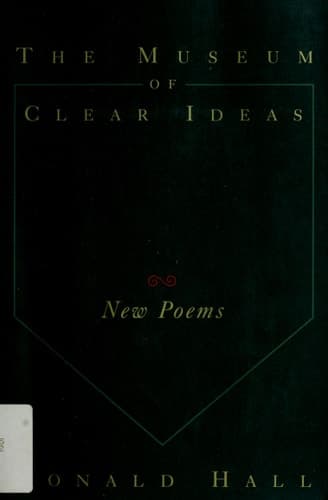
The Museum of Clear Ideas: New Poems
Donald HallPublished1993
Pages128
Formathardcover
PublisherTicknor & Fields
Synopsis
This is Donald Hall's most advanced works extending his poetic reach even beyond his recent volumes, The One Day and Old and New Poems. Conflict dominates this book, and conflict unites it. Hall takes poetry as an instrument for revelation and discovery, whether in "Another Elegy," a comic, pathetic portrait of a (fictional) contemporary poet, or in "Baseball," in which a narrator called K.C. (swinging his bat from the Mudville of the poet's desk) fantastically attempts to explain the all-American game to a long-dead German artist. "Baseball" occupies nine innings, each inning composed of nine stanzas, each stanza composed of nine lines, each line composed of nine syllables.
The title series of poems, "The Museum of Clear Ideas," imitates, but does not translate, the first book of the Odes of Horace. A cool, witty voice identifies itself as Horace Horsecollar, an old Walt Disney character; yet no sooner does one voice establish itself than another voice contradicts it. By such means are ideas exhibited and clarified. The book's final section, "Extra Innings," moves with terrible poignancy to questions about the end of the game, each inning adding another stanza, each stanza another line, each line another syllable, until the game is over.
The Museum of Clear Ideas, exalting artifice, breaks beyond artifice to the heart of reality. As Thom Gunn wrote of Hall's The One Day, "It is one of those books, like Elizabeth Bishop's last collection, which alters the way we look at the jumbled contents of the poetic career preceding it, giving it retrospectively a shape, a pattern, a consistency it didn't seem to have at the time."
Recommendations
Generating recommendations…
Our AI is preparing recommendations for The Museum of Clear Ideas: New Poems. This usually takes under a minute.
About Donald Hall
D
Donald Hall
1928–2018
Donald Andrew Hall Jr. (September 20, 1928 – June 23, 2018) was an American poet, writer, editor and literary critic. He was the author of over 50 books across several genres from children's literature, biography, memoir, essays, and including 22 volumes of verse. Hall was a graduate of Phillips Exeter Academy, Harvard, and Oxford. Early in his career, he became the first poetry editor of The Paris Review (1953–1961), the quarterly literary journal, and was noted for interviewing poets and other authors on their craft. On June 14, 2006, Hall was appointed as the Library of Congress's 14th Poet Laureate Consultant in Poetry (commonly known as "Poet Laureate of the United States"). He is regarded as a "plainspoken, rural poet," and it has been said that, in his work, he "explores the longing for a more bucolic past and reflects [an] abiding reverence for nature." Hall was respected for his work as an academic, having taught at Stanford University, Bennington College and the University of Michigan, and having made significant contributions to the study and craft of writing.
View author page