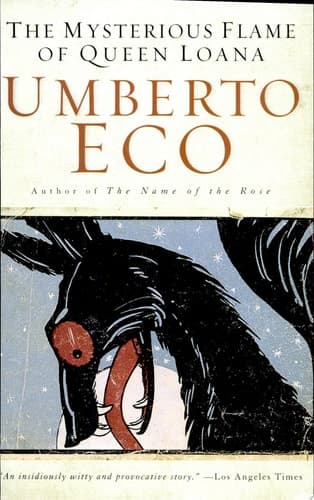
The Mysterious Flame of Queen Loana
Umberto EcoPublished2006
Pages480
Formatpaperback
PublisherHoughton Mifflin Harcourt
Synopsis
International bestselling and award-winning author Umberto Eco's illustrated novel The Mysterious Flame of Queen Loana is "an insidiously witty and provocative story" (Los Angeles Times).
Yambo, a sixtyish rare-book dealer who lives in Milan, has suffered a loss of memory -- he can remember the plot of every book he has ever read, every line of poetry, but he no longer knows his own name, doesn't recognize his wife or his daughters, and remembers nothing about his parents or his childhood. In an effort to retrieve his past, he withdraws to the family home somewhere in the hills between Milan and Turin.
There, in the sprawling attic, he searches through boxes of old newspapers, comics, records, photo albums, and adolescent diaries. And so Yambo relives the story of his generation: Mussolini, Catholic education and guilt, Josephine Baker, Flash Gordon, Fred Astaire. His memories run wild, and the life racing before his eyes takes the form of a graphic novel. Yambo struggles through the frames to capture one simple, innocent image: that of his first love.
A fascinating, abundant novel -- wide-ranging, nostalgic, funny, full of heart -- from the incomparable Eco.
Recommendations
Generating recommendations…
Our AI is preparing recommendations for The Mysterious Flame of Queen Loana. This usually takes under a minute.
About Umberto Eco
U
Umberto Eco
1932–2016
Umberto Eco (5 January 1932 – 19 February 2016) was an Italian novelist, literary critic, philosopher, semiotician, and university professor. He is widely known for his 1980 novel Il nome della rosa (The Name of the Rose), a historical mystery combining semiotics in fiction with biblical analysis, medieval studies, and literary theory. He later wrote other novels, including Il pendolo di Foucault (Foucault's Pendulum) and L'isola del giorno prima (The Island of the Day Before). His novel Il cimitero di Praga (The Prague Cemetery), released in 2010, topped the bestseller charts in Italy. Eco also wrote academic texts, children's books, and essays, and edited and translated into Italian books from French, such as Raymond Queneau’s “Exercises in Style” (1983). He was the founder of the Department of Media Studies at the University of the Republic of San Marino,[3] president of the Graduate School for the Study of the Humanities at the University of Bologna, member of the Accademia dei Lincei, and an honorary fellow of Kellogg College, Oxford.
View author page