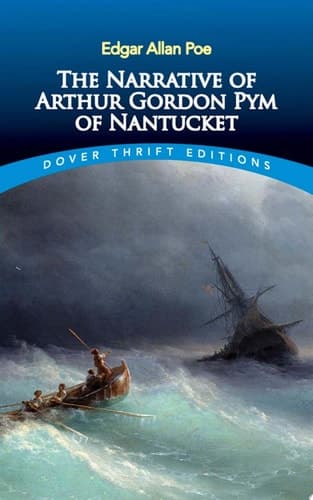
The Narrative of Arthur Gordon Pym of Nantucket
Edgar Allan PoePublished2005
Pages176
Formatpaperback
PublisherCourier Corporation
Synopsis
From the author who introduced readers to horrifying tales of murder, a raven that quoth "Nevermore," and other macabre masterpieces comes a novella based on factual accounts of a haunting, mutinous trip on the high seas. What begins with a young Nantucket man stowing away on a New Bedford whaler ends with only two survivors drifting toward the South Pole in a canoe. This engrossing tale is sure to be enjoyed by Poe readers and maritime enthusiasts alike.
Recommendations
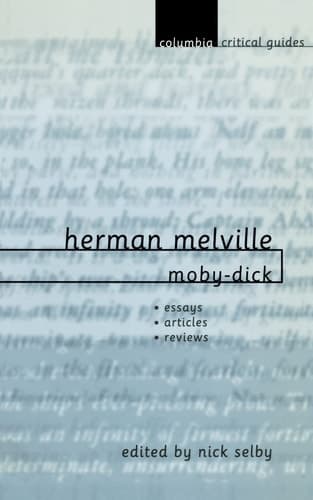
Herman Melville, Moby-Dick
by Richard Beynon
You've already experienced Poe's claustrophobic terror at sea, so now meet Melville's obsessive captain pursuing his white whale across the same waters Pym navigates. Where Poe gives you dread and mutiny, Melville gives you philosophical meditation wrapped in maritime detail—the whaling logs, the cetology chapters, the sense that the ocean itself is a character with its own incomprehensible logic. Both novels treat the sea as a place where civilization's rules dissolve, but Melville lingers in that dissolution longer, making it almost transcendent.
View book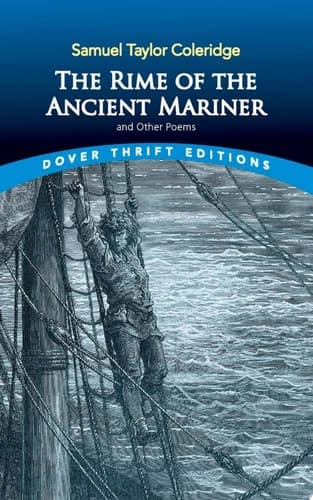
The Rime of the Ancient Mariner and Other Poems
by Samuel Taylor Coleridge
This is a poem, not a novel, which might feel like a left turn—but hear me out. Coleridge captures that same fever-dream quality Poe builds throughout Pym, where the narrator's reliability fractures and supernatural dread creeps in alongside natural disaster. The repetitive, hypnotic rhythm mirrors the psychological unraveling of Pym himself, and Coleridge's mariner, like Pym, is cursed by knowledge of something the reader can barely comprehend. It's shorter than Pym but denser, and it'll rewire how you read maritime literature.
View book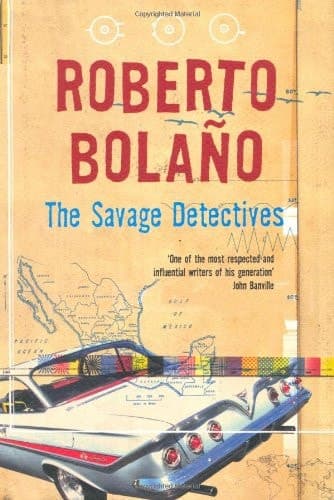
The Savage Detectives A Novel
by Roberto Bolaño
This is my surprise pick, and I'm recommending it because Bolaño does something Poe only hints at: he makes obsession the actual plot. Two young poets chase a literary mystery across Mexico and Europe, and the novel becomes this labyrinthine pursuit that mirrors Pym's descent toward the unknown—except here the unknown is human, textual, possibly nonexistent. It's fragmented and demanding, but if you loved how Poe makes you feel unmoored and uncertain about what's real, Bolaño will do that to you across 900 pages. The paranoia is literary rather than supernatural, but it's just as disorienting.
View book
The Wreck of the Belle, the Ruin of La Salle (Number 48: Centennial Series of the Association of Former Students, Texas A&M University) (Volume 88)
by Robert S. Weddle
Stevenson and Lloyd Osbourne wrote this novel as a deliberate response to maritime adventure fiction, and it's got the same salvage-and-survival bones as Pym but with a darker, more cynical edge about human nature. Two men investigate a shipwreck and uncover layers of deliberate sabotage and greed—the horror here isn't the sea itself but what people do to each other on it. Stevenson's prose is cleaner than Poe's, but the moral ambiguity and the sense that civilization is just a thin veneer over brutality will feel very familiar.
View bookAbout Edgar Allan Poe
E
Edgar Allan Poe
1809–1849
Edgar Allan Poe was an American writer, poet, editor and literary critic, considered part of the American Romantic Movement. Best known for his tales of mystery and the macabre, Poe was one of the earliest American practitioners of the short story and is considered the inventor of the detective-fiction genre. He is further credited with contributing to the emerging genre of science fiction.[1] He was the first well-known American writer to try to earn a living through writing alone, resulting in a financially difficult life and career.[2] Source and more information: https://en.wikipedia.org/wiki/Edgar_Allan_Poe
View author page