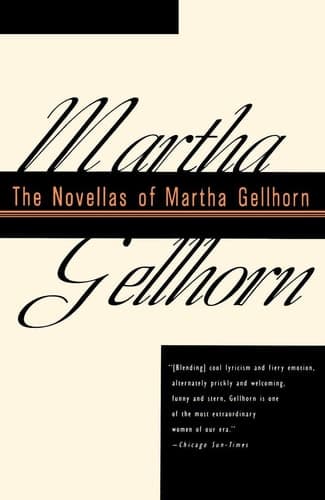
The Novellas of Martha Gellhorn
Martha GellhornPublished1994
Pages636
Formatpaperback
PublisherNational Geographic Books
Synopsis
“[Blending] cool lyricism and fiery emotion, alternately prickly and welcoming, funny and stern, Gellhorn is one of the most extraordinary women of our era.”—Chicago Sun-Times
Spanning more than 40 years and settings that range from Depression-era America to the smartest London dinner parties to the highlands of East Africa, the novellas of Martha Gellhorn display the same qualities that have made her one of the most famous journalists of the twentieth century: an indelible sense of place, prose of breathtaking swiftness and precision, and an unerring fix on the hidden motives of her characters. Above all, Martha Gellhorn explores the ways men and women live privately—and often passionately—amid the rush of history.
“Reading Martha Gellhorn for the first time is a staggering experience. She is not a travel writer or a journalist or a novelist: she is all of these, and one of the most eloquent witnesses of the twentieth century.”—Bill Buford, Granta
“Martha Gellhorn is one of our very best writers. To the swift and vibrant medium of the [novella], she brings a richness of experience, a tenderness and depth of feeling.”—The Atlantic
“Peerless and hilarious . . . Martha Gellhorn is a wittily astringent writer.”—Vogue
Recommendations
Generating recommendations…
Our AI is preparing recommendations for The Novellas of Martha Gellhorn. This usually takes under a minute.
About Martha Gellhorn
M
Martha Gellhorn
1908–1998
Martha Gellhorn was born in St. Louis, Missouri, the daughter of a suffragette and a gynecologist. In 1926 she graduated from John Burroughs School and then attended Bryn Mawr College in Philadelphia. In 1927, she left before graduating to pursue a career as a journalist. In 1930 she went to France for two years where she worked as a foreign correspondent for the United Press. While in Europe, she became active in the pacifist movement, which she wrote about in her first book, What Mad Pursuit (1934). Upon returning to the U.S., she worked as an investigator for the Federal Emergency Relief Administration, reporting on the impact of the Depression on the United States. Her reports caught the attention of Eleanor Roosevelt, and the two women became lifelong friends. In 1936, on a trip to Key West, she met the author Ernest Hemingway. They travelled together in Spain, where she was reporting on the Spanish Civil War for Collier's Weekly. Later, she reported on the rise of Adolf Hitler in Germany and in 1938 she was working in Czechoslovakia. She later reported the war from Finland, Hong Kong, Burma, Singapore and Britain. She was among the first journalists to report from Dachau concentration camp after it was liberated. She married Hemingway in 1940, but her career as a journalist kept travelling for long periods of time, and they divorced in 1945. After the war, she covered the Vietnam War, the Six-Day War in the Middle East, and the civil wars in Central America for the Atlantic Monthly. In 1949, she adopted a son from an Italian orphanage, and although she was briefly a devoted mother, she soon left him to the care of her relatives in Englewood, and he eventually ended up in boarding school. She married Tom Matthews, editor-in-chief of Time magazine, in 1954; they were divorced in 1963. Aged 81, she travelled impromptu to Panama, where she wrote on the U.S. invasion. Only when the Bosnian war broke out in the 1990s did she concede she was too old to continue her career as a war correspondent. She died in London in 1998, aged 89, taking her own life after a long battle with cancer and near total blindness. She is considered to be one of the greatest war correspondents of the 20th century. Gellhorn published a large number of books, including a collection of articles on war, The Face of War (1959), a novel about McCarthyism, The Lowest Trees Have Tops (1967), an account of her travels (including one trip with Ernest Hemingway), Travels With Myself and Another (1978) and a collection of her peacetime journalism, The View From the Ground (1988). Her selected letters were published posthumously in 2006.
View author page