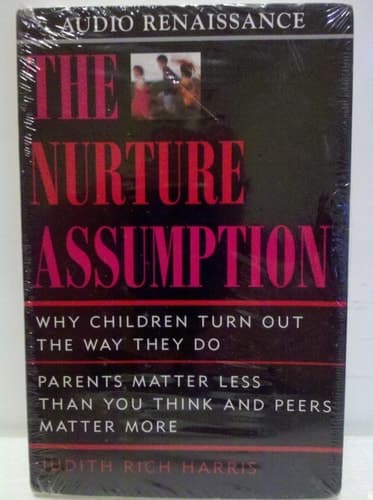
The Nurture Assumption: Why Children Turn Out the Way They Do : Parents Matter Less Than You Think and Peers Matter More
Judith Rich HarrisPublished1998
Pages102
Formataudiobook
PublisherMacmillan Audio
Synopsis
Product Description
With a radical and welcome departure from traditional child-development theories, Harris expertly argues that parents are not the defining influence on children. Rather, one's personality is shaped by the group whom one most identifies with. Here, Harris challenges our most common beliefs about who we are and how we came to be that way. Using examples from folklore and literature, as well as scientific research and personal experience, she shows listeners the world of childhood in all its richness and complexity, and explains that people were designed by evolution to be socialized in groups, not at home. Abridged. November '98 publication date.
From Library Journal
Harris both annoyed and intrigued specialists everywhere last year with the publication of her theory that neither nature nor nurture has the greatest influence upon child development. Rather, she asserts, the peer group is the determining factor in children's growth and personality development. Beginning with a look at traditional child development theories, Harris then builds a convincing case for her theory based on observation, anecdotes, and research-based data. Inspired partly by her desire to relieve the guilt and anxiety felt by parents determined to provide the best environment for their offspring, Harris contends, through narration by Paula Parker, that the only true impact parents can have is to encourage children to identify with appropriate peers and to ensure that children fit in. Although her theory is extreme, there is much to consider and react to, making this an interesting addition to library collections that include parenting resources.ASusan McCaffrey, Haslett H.S., MI
Copyright 1999 Reed Business Information, Inc.
Recommendations
Generating recommendations…
Our AI is preparing recommendations for The Nurture Assumption: Why Children Turn Out the Way They Do : Parents Matter Less Than You Think and Peers Matter More. This usually takes under a minute.
About Judith Rich Harris
Biography coming soon.
View author page