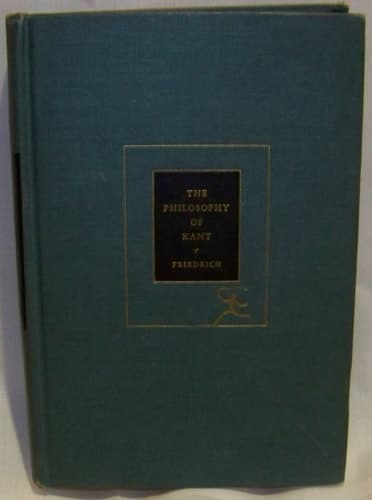
The Philosophy of Kant Immanuel Kant's Moral and Political Writings
Immanuel KantPublished1993
Pages525
Formathardcover
PublisherModern Library
Synopsis
Many contemporaries criticized him for smashing the Age of Reason. Goethe, however, remarked that reading a page of Immanuel Kant was like entering a bright and well-lighted room: The great eighteenth-century philosopher illuminated everything he ever pondered. The twelve essays in this volume reveal Kant's towering importance as an ethical and social thinker as well as his enduring influence on the shape of philosophy. Included are excerpts from Dreams of a Visionary, Prolegomena to Every Future Metaphysics, Metaphysical Foundations of Morals, Critique of Judgement, and Eternal Peace.
As Professor Friedrich writes in his introduction to this volume: "The problem of freedom, the freedom of the human personality to unfold and fulfill its higher destiny, is the central issue of all of Kant's philosophizing."
Recommendations
Generating recommendations…
Our AI is preparing recommendations for The Philosophy of Kant Immanuel Kant's Moral and Political Writings. This usually takes under a minute.
About Immanuel Kant
I
Immanuel Kant
1724–1804
Immanuel Kant was an 18th-century German philosopher from the Prussian city of Königsberg. Kant was the last influential philosopher of modern Europe in the classic sequence of the theory of knowledge during the Enlightenment beginning with thinkers John Locke, George Berkeley, and David Hume. Kant created a new perspective in philosophy which had widespread influences on philosophy continuing through to the 21st century. He published important works on epistemology, as well as works relevant to religion, law, and history. One of his most prominent works is the *Critique of Pure Reason*, an investigation into the limitations and structure of reason itself. It encompasses an attack on traditional metaphysics and epistemology, and highlights Kant's own contribution to these areas. The other main works of his maturity are the *Critique of Practical Reason*, which concentrates on ethics, and the *Critique of Judgment*, which investigates aesthetics and teleology. <sup>[1][1]</sup> [1]: https://en.wikipedia.org/wiki/Immanuel_Kant
View author page